
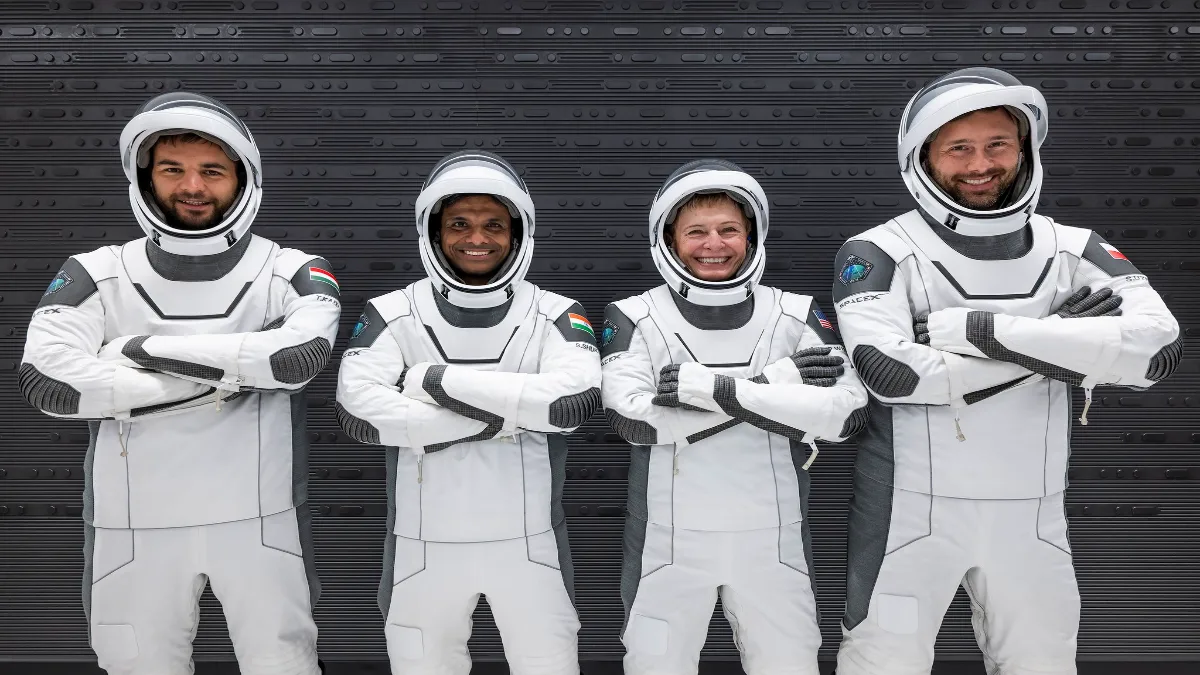
Once again, Shubhanshu Shukla’s long-anticipated journey to the International Space Station (ISS) got deferred after a liquid oxygen leak was detected. Shubhanshu Shukla is the second Indian to fly to the ISS after Rakesh Sharma back in 1984.
ISRO and NASA’s SpaceX have collaborated to carry out the Axiom 4 Mission. The Axiom 4 Mission was set to launch from NASA’s Kennedy Space centre in Florida on June 10. It was earlier scheduled to be launched on June 8, and then it was postponed to June 10. Due to inclement weather, it was further rescheduled to be launched on June 11.
Why was the mission delayed a third time?
Unfortunately, the mission was held up due to oxygen leakage. After conducting a static fire test of the Falcon 9 vehicle, checks were carried out, when the leak was detected. The leak was spotted in the propulsion bay, as verified by the Indian Space Research Organisation (ISRO).
🚀 Countdown to liftoff!
🚀The #Ax4 crew and @SpaceX teams successfully complete a full launch day rehearsal ahead of Tuesday’s mission to the @Space_Station.
🚀Indian astronaut #ShubhanshuShukla, serving as the mission pilot of the Axiom-4 (Ax4) commercial mission to the #ISS,… pic.twitter.com/YydwJPNcpp
— All India Radio News (@airnewsalerts) June 9, 2025
Orbit alignment in space missions plays a vital role as it guarantees the path of the spacecraft. From media reports, it has been known that the rocket will circle in two stages. The first stage contains the liquid oxygen and rocket-grade kerosene, which is essential to fulfil the journey. Hence, the oxygen leak is a crucial concern for everyone. Unless the problem is dealt with, it may halt the mission from moving forward.
The agency further added that steps will be taken to solve the leakage issue. No further date for the launch has yet been announced.
ISRO’s chairman, Dr. V. Narayanan, has emphasized that once the leak is fixed, the launch will resume. Deferring the mission was indispensable because it involves human lives.
All you need to know about Axiom 4
Axiom 4 Mission is the second human spacelift in which nationals from three nations, namely India, Poland, and Hungary, will go on board. The Crew members include Commander Peggy Whitson, a former NASA astronaut, Indian pilot Shubhanshu Shukla, Slawosz Uznanski-Wisniewski, Poland’s mission specialist, and Hungarian astronaut Tibor Kapu.
India’s Objectives in this Mission
The mission duration of the SpaceX Falcon 9 is 14 days. The Mission will conduct over 60 experiments out of which 7 Indian experiments will be spearheaded by Shubhanshu Shukla. The experiments will be performed with a key focus on fields like biological science, health, tech, and earth, and space studies.
This mission underscores India’s return to human space exploration. It seeks to strengthen ISRO and NASA’s partnership. It will also offer valuable insights into space studies and will inspire future space missions.
