
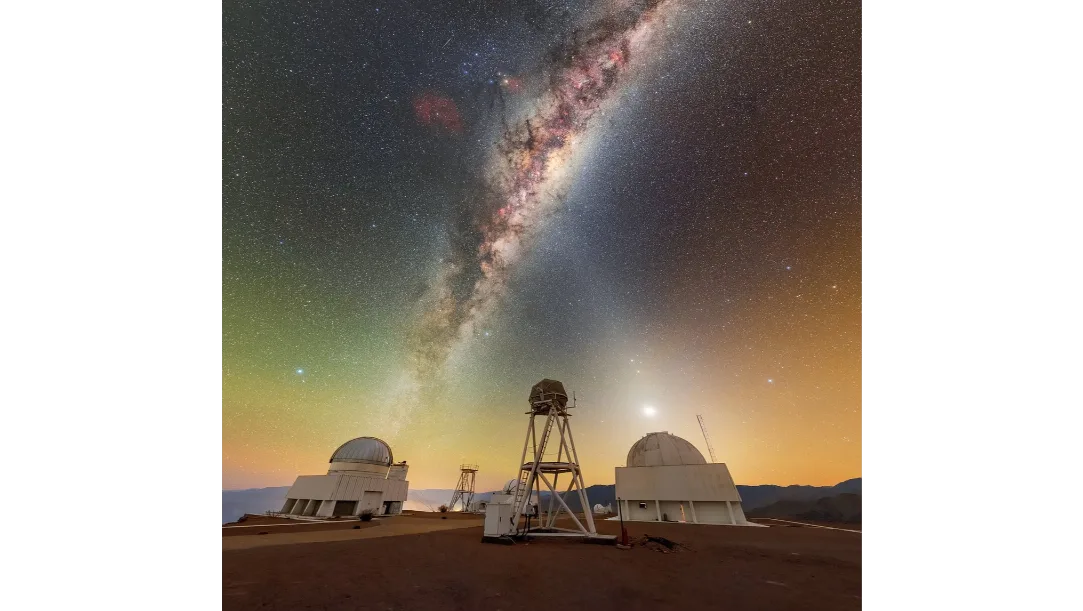
In a mesmerizing display of cosmic artistry, a giant X appeared over Chile as two celestial beams of light crossed paths in the night sky. This captivating phenomenon, captured in a stunning space photo of the week, showcases the intersection of the Milky Way and zodiacal light above the Cerro Tololo Inter-American Observatory.
The giant X, formed by these celestial beams of light crossing space, highlights the wonders of astronomy in one of Earth’s darkest skies, drawing global attention to Chile’s role in celestial observations.
Celestial Beams Unveiled: Milky Way and Zodiacal Light in Harmony
The giant X over Chile stems from the luminous band of the Milky Way, teeming with stars and nebulae, intersecting with the faint glow of zodiacal light.
Described as “the biggest visible solar system phenomenon in the night sky,” zodiacal light arises from sunlight reflecting off interplanetary dust, possibly from asteroids, comets, or even particles blown off Mars, reports Live Science.
This diffuse glow, often termed “false dawn” or “false dusk,” is brightest around equinoxes and appears as a triangular beam along the ecliptic plane.
Meanwhile, the Milky Way’s bright core, visible through constellations like Scorpius, Sagittarius, and Ophiuchus, shines vividly from the Southern Hemisphere, creating the dramatic cross that forms the giant X.
Iconic Space Photo of the Week Captured in Chile’s Andes
The space photo of the week, shared on August 6, 2025, was originally taken in 2022 by astrophotographer Petr Horálek during his tenure as an audiovisual ambassador for NOIRLab.
Perched at 7,200 feet in the Chilean Andes within the southern Atacama Desert, the Cerro Tololo Inter-American Observatory provides an ideal vantage point for such celestial beams.
The image features several key telescopes in the foreground, including the U.S. Naval Observatory Deep South Telescope, the DIMM1 Seeing Monitor, the Chilean Automatic Supernova Search dome, the UBC Southern Observatory, and the Planetary Defense 1.0-meter Telescope.
Horálek’s composition masterfully captures the giant X as the celestial beams of light cross space, emphasizing the observatory’s silhouette against the starry backdrop.
Scientific Context: Dust, Stars, and the Quest for Clear Skies
Astronomers explain that the zodiacal light’s origins remain a topic of intrigue, with a 2020 study suggesting Martian dust as a potential contributor. This faint celestial beam, harder to spot due to its subtlety, contrasts with the Milky Way’s dense stellar population, making their intersection a rare visual treat.
Chile’s high-altitude sites like Cerro Tololo are favored for building advanced telescopes precisely because they offer unobstructed views of the Milky Way’s core, free from light pollution.
As the article notes, these locations enable humanity’s best glimpses into the universe, where celestial beams like these can form spectacular patterns such as the giant X over Chile.
Broader Implications for Astronomy and Stargazing Enthusiasts
This giant X over Chile not only serves as a space photo of the week but also inspires stargazers worldwide to seek out dark-sky locations. Author Jamie Carter, a seasoned freelance journalist specializing in astronomy, highlights such phenomena in his works, including “A Stargazing Program For Beginners.”
