
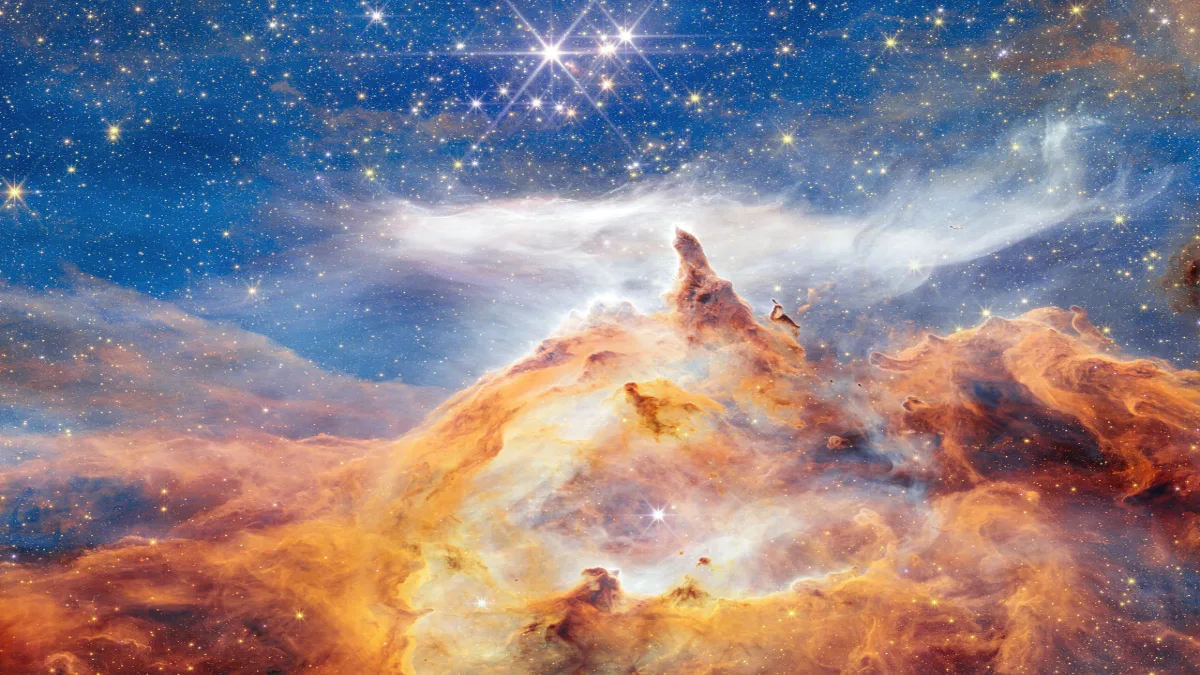
September 5, 2025 — Space & Science: NASA’s James Webb Space Telescope has unveiled a breathtaking new image of “Pismis 24,” a young star cluster nestled deep within the “Lobster Nebula,” located approximately 5,500 light-years away in the constellation Scorpius.
The image, captured using Webb’s Near-Infrared Camera (NIRCam), reveals a glittering landscape of massive newborn stars, glowing gas, and towering cosmic spires. What looks like a fantasy mountaintop kissed by clouds is actually a dust-scape being sculpted by intense radiation and stellar winds.
“Webb is the only telescope with the spatial resolution and sensitivity to study planet-forming disks in massive star-forming regions,” said María Claudia Ramírez-Tannus of the Max Planck Institute for Astronomy.
At the heart of the cluster lies “Pismis 24-1,” once believed to be the most massive star ever discovered. Scientists now know it’s actually a pair of stars—each weighing in at 74 and 66 solar masses—still among the most luminous ever observed.
Pismis 24 stars
Thousands of stars of varying sizes and colors fill the frame, with the largest ones displaying signature six-point diffraction spikes. These are the most massive stars in the cluster, while smaller members appear in hues of white, yellow, and red depending on their dust coverage.
Lobster Nebula image
The Lobster Nebula, also known as NGC 6357, is one of the closest and most active star-forming regions. Webb’s image shows streamers of hot ionized gas, wispy veils of dust, and dramatic spires that stretch over 5 light-years—each shaped by the fierce forces of stellar birth.
James Webb discovery
This latest capture adds to Webb’s growing portfolio of deep-space discoveries, offering rare insight into how massive stars form and evolve. The image also reveals tens of thousands of background stars from the Milky Way, adding depth to the cosmic scene.
Infrared space photo
Using infrared light, Webb penetrates dense clouds of gas and dust, exposing regions invisible to traditional telescopes. The colors in the image represent different elements: cyan for hot hydrogen, orange for dust, and red for cooler molecular gas.
“Pismis 24” is more than a stunning visual—it’s a window into the birth of stars and the raw power of cosmic creation. Thanks to Webb’s precision and depth, scientists and space enthusiasts alike can now witness the drama of the universe unfolding in real time.
