
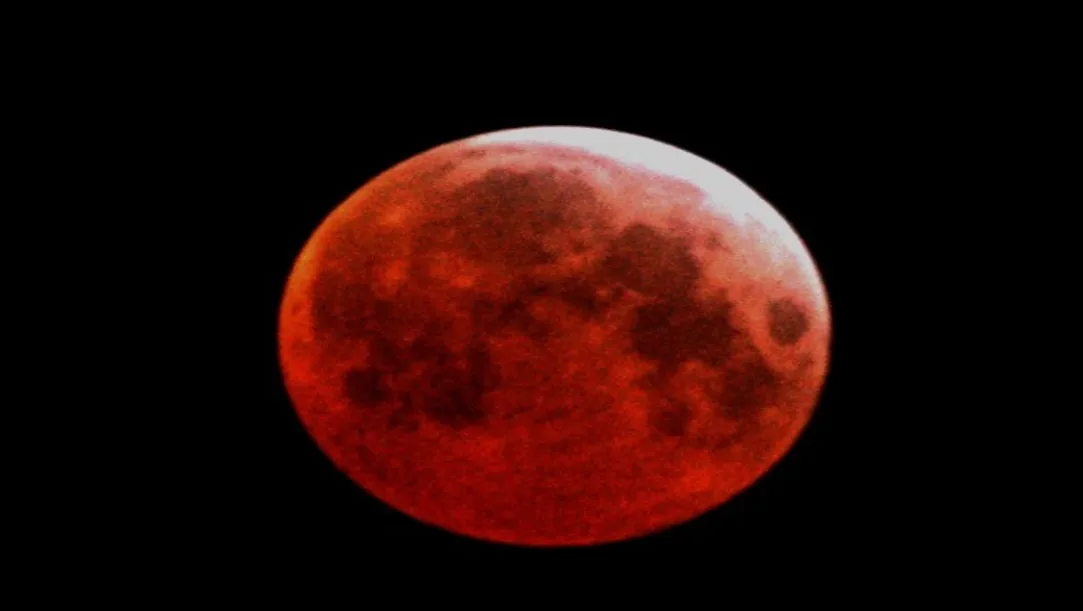
The Moon is mysteriously rusting and turning red, and scientists now believe Earth may be the unexpected culprit.
A groundbreaking study published in Geophysical Research Letters reveals that oxygen leaking from Earth’s atmosphere could be triggering the formation of hematite—a reddish iron oxide—on the Moon’s poles.
This discovery is reshaping how we understand lunar chemistry and the deep, invisible ties between Earth and its only natural satellite.
Why Is the Moon Rusting Despite No Atmosphere?
The Moon lacks a breathable atmosphere and is constantly bombarded by hydrogen from solar winds, which should prevent rust formation.
Yet, researchers have found hematite (Fe₂O₃) near the lunar poles. Hematite typically forms through oxidation—a process requiring oxygen and water.
So how is rust forming on the Moon?
Planetary scientist Xiandi Zeng of Macau University of Science and Technology explains:
“We conducted a series of oxygen and hydrogen irradiation experiments to simulate lunar surface irradiation processes. For the first time, our experiments demonstrate both the formation and reduction of hematite minerals”.
How Is Earth’s Oxygen Reaching the Moon?
During the full Moon phase, Earth’s magnetotail—a trailing region of its magnetic field—funnels oxygen ions toward the Moon. For about five days each month, the Moon is shielded from solar wind and instead receives a steady stream of Earth’s oxygen.
The research team noted:
“Earth wind, the primary source of energetic oxygen ions on the Moon, acts as the oxidant, driving the oxidation of various minerals, including metallic iron and iron-bearing oxides and sulfides abundant in lunar regolith”.
This process selectively oxidizes minerals like ilmenite and troilite, while silicates such as pyroxene and olivine remain unaffected.
Can Solar Wind Reverse Lunar Rust?
To test whether solar wind could undo the rusting, scientists exposed hematite to hydrogen ion beams. They found that only high-energy beams—similar to Earth’s oxygen wind—could reverse the oxidation. The solar wind, with its lower energy, failed to do so.
This explains why hematite is concentrated near the Moon’s poles, where Earth’s magnetotail delivers oxygen ions while deflecting hydrogen.
Mind blown 🤯! Did you know the MOON is RUSTING? 🌕💡 Scientists have detected hematite, a form of iron oxide or rust, on the lunar surface, particularly around the poles! ❄️ #SpaceMysteries #RustInPeace #MoonFacts #SpaceExploration #NASA #ARTEMIS @Grok pic.twitter.com/z3Pu1zNvrF
— Major Howell 👑🤖 (@MajorWHowell) September 7, 2025
What Does This Mean for Space Science?
The Moon rusting due to Earth’s oxygen suggests a long-standing material exchange between the two bodies.
Researchers believe this interaction may date back over 4 billion years, possibly preserving a chemical record of Earth’s atmospheric history—including the Great Oxidation Event 2.4 billion years ago.
With missions like Chandrayaan-3 and China’s Chang’E-7 targeting the lunar south pole, scientists hope to gather more data to understand this cosmic connection.
Earth’s Hidden Fingerprint on the Moon
The Moon is mysteriously rusting and turning red, and Earth’s leaking oxygen appears to be the hidden trigger.
This discovery not only deepens our understanding of lunar geology but also reveals how Earth’s influence extends far beyond gravity—etching its chemical signature into the Moon’s surface.
