
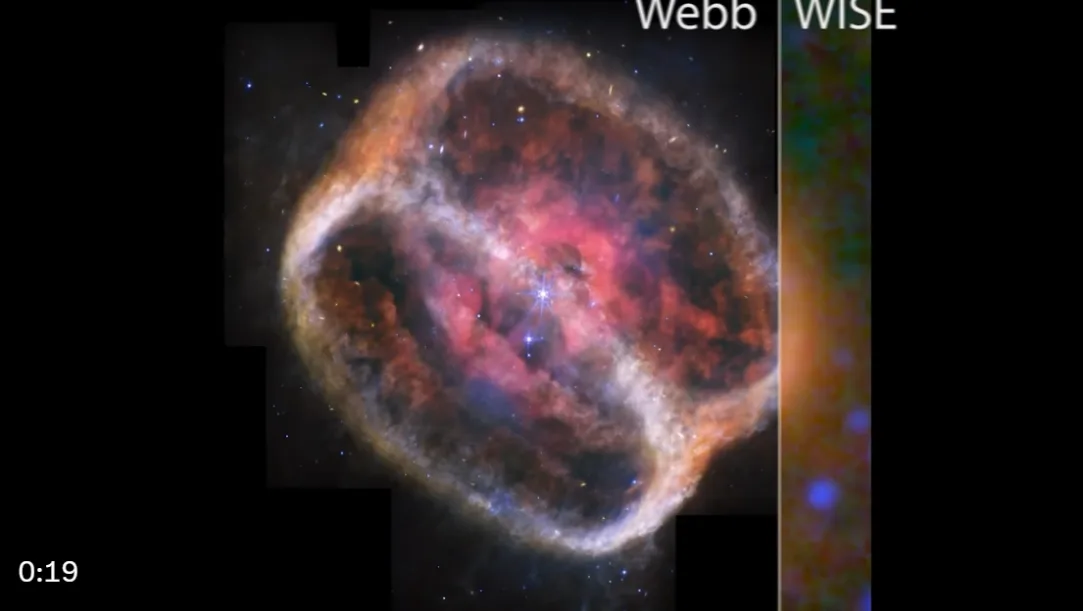
The Planetary Nebula NGC 1514, also known as the Crystal Ball Nebula, has received a breathtaking new look thanks to NASA’s James Webb Space Telescope (Webb).
Compared to earlier images captured by the Wide-field Infrared Survey Explorer (WISE), Webb’s observations reveal unprecedented clarity and detail. A newly released comparison video highlights just how much of an improvement Webb brings to our understanding of this cosmic wonder.
Planetary Nebula NGC 1514: From WISE to Webb
Discovered in the 18th century by astronomer William Herschel, NGC 1514 lies about 2,300 light-years away in the constellation Taurus. WISE, launched in 2009, mapped the entire sky in infrared light and provided the first wide-field view of the nebula.
However, Webb’s 6.5-meter primary mirror and advanced instruments like the Mid-Infrared Instrument (MIRI) have transformed that view into a high-resolution masterpiece.
Unlike WISE, which offered broad but less detailed coverage, Webb’s precision allows astronomers to see the intricate rings, gas clouds, and dust structures surrounding the dying star at the nebula’s core. This leap in resolution is why scientists are calling it a “big improvement.”
Why the Crystal Ball Nebula Matters
The Crystal Ball Nebula is a planetary nebula formed when a dying star sheds its outer layers, creating a glowing shell of gas and dust.
Webb’s new images show complex filaments and overlapping rings that were invisible in WISE’s earlier data. These details help astronomers study how stars evolve and recycle material back into the galaxy.
NASA’s visualization team noted: “The James Webb Space Telescope gives stunning clarity and depth to planetary nebula NGC 1514, revealing details hidden in the colorful interior for the first time.”
Video Comparison: WISE vs Webb
NASA has released a side-by-side video comparison of the nebula as seen by WISE and Webb. The video begins with WISE’s softer, less detailed view and transitions into Webb’s sharper, color-coded composite.
A big improvement: Planetary Nebula NGC 1514 (also known as the Crystal Ball Nebula) as seen by WISE vs Webb
Credit: NASA, ESA, CSA, STScI, NASA-JPL, Caltech, UCLA, Michael Ressler (NASA-JPL), Dave Jones (IAC) pic.twitter.com/j5wLOMx9Oz
— World and Science (@WorldAndScience) September 30, 2025
This visual crossfade demonstrates the dramatic leap in resolution and sensitivity, making the Crystal Ball Nebula appear more vibrant and structured than ever before.
A New Era of Cosmic Imaging
The WISE vs Webb comparison of NGC 1514 is more than just a visual upgrade—it represents the future of astronomy.
With Webb’s ability to capture faint details across multiple wavelengths, scientists can now probe the life cycle of stars with unmatched precision. Additionally, the Crystal Ball Nebula serves as a striking example of how modern telescopes are rewriting our understanding of the universe.
Webb’s Big Improvement on NGC 1514
The Planetary Nebula NGC 1514 (Crystal Ball Nebula), once a hazy object in WISE’s view, now shines in extraordinary detail through Webb’s lens.
The comparison video underscores just how far space imaging has come, offering both scientists and the public a deeper appreciation of the cosmos. For astronomy enthusiasts, this is indeed a big improvement worth watching.
