
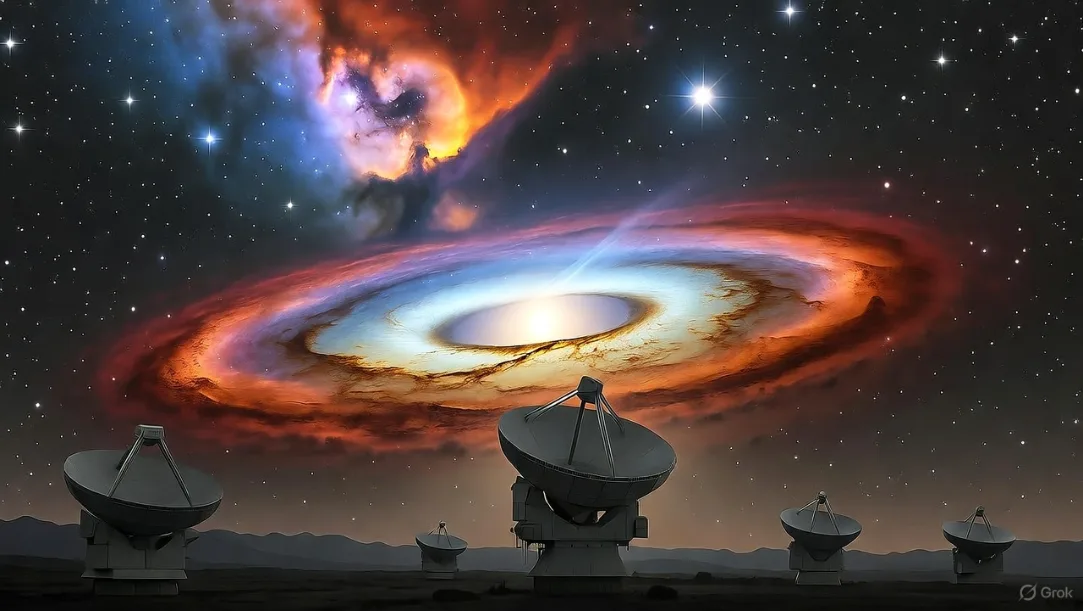
In a groundbreaking discovery, scientists have detected heavy water in a planet-forming disk for the first time.
This rare form of water, known as D₂O, was found around the young star V883 Orionis, located 1,300 light-years away in the Orion constellation.
According to Space.com, this finding suggests that some water in our solar system may be older than the Sun itself.
What Is Heavy Water in an Exoplanet Disk?
Heavy water contains deuterium, a heavier isotope of hydrogen. Unlike regular H₂O, D₂O forms under extremely cold conditions.
Scientists used the Atacama Large Millimeter/submillimeter Array (ALMA) in Chile—a network of 66 radio dishes—to detect this ancient water.
The discovery marks the first time heavy water has been observed in a disk where planets are actively forming.
Stats Behind the Discovery
- Star observed: V883 Orionis
- Distance from Earth: ~1,300 light-years
- Instrument used: ALMA (66 radio dishes)
- Water type: Doubly deuterated water (D₂O)
According to ALMA Observatory, “This means that the water in this disk, and by extension the water in comets that form here, existed long before the birth of the star itself.”
“Our detection indisputably demonstrates that the water seen in this planet-forming disk must be older than the central star and formed at the earliest stages of star- and planet-formation,” said Margot Leemker, of the University of Milan, who led the study.
“This presents a major breakthrough in understanding the journey of water through planet formation, and how this water made its way to our solar system and possibly Earth, through similar processes.”
Why This Matters
This discovery supports the theory that water travels unchanged from interstellar clouds into planet-forming regions.
Notably, it could explain how water reached Earth and other planets. Additionally, it opens new doors for studying the origins of life and the chemical evolution of planetary systems.
Expert Reactions
Lead astronomer John J. Tobin said, “This is the first direct evidence of water’s interstellar journey from clouds to the materials that form planetary systems—unchanged and intact.”
Cosmic Origins of Water
With rising interest in space exploration and exoplanet research, this discovery adds a new layer to our understanding of cosmic chemistry.
It also strengthens the case for studying water in distant planetary systems to trace the building blocks of life.
