
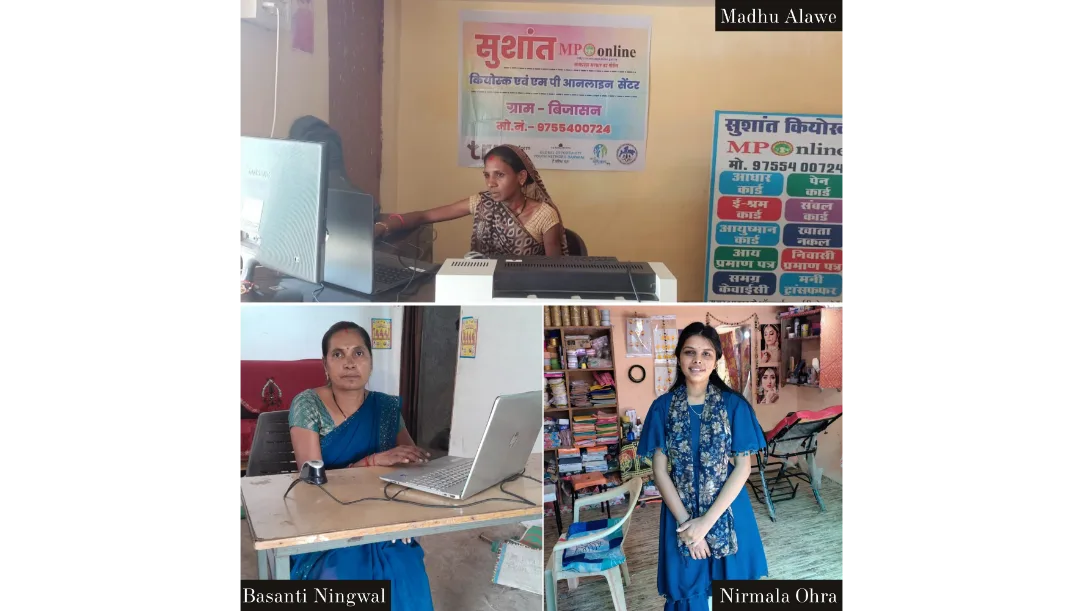
Basanti Ningwal, Madhu Alawe, and Nirmala Ohra’s success has shown that learning doesn’t end with school.
India’s dream of becoming a $35 trillion economy by 2047 must also take into cognisance the vast untapped potential of rural Indians.
With improved infrastructure, better connectivity, wider distribution networks, and targeted policies, the participation of rural citizenry can be encouraged to some extent.
But lasting progress will depend on deeper structural change, creating an ecosystem of systemic support, mentorship, and localised knowledge that strengthens community-led progress. Such an approach ensures inclusion, especially for those who have limited or no access to formal education.
On National Education Day (11th November), the success stories of rural entrepreneurs Basanti Ningwal, Madhu Alawe, and Nirmala Ohra prove that community-based training, digital exposure, and enterprise support can redefine knowledge beyond conventional classrooms.
They remind us that the journey to true learning and progress begins when local aspirations are nurtured with the right support.
1. Basanti Ningwal
With the help of Transform Rural India (TRI), a development design organisation that works to transform India’s bottom 1,00,000 villages into flourishing localities, Basanti Ningwal moved beyond a life of limited opportunities to become an inspirational role model.
With enterprise support from TRI’s Enterprise Facilitation Hub, she has not only built a sustainable livelihood but also catalysed change in her village.
The 40-year-old entrepreneur from Abahli village in the Thikri block of Barwani district belongs to the Scheduled Tribe community and could only study up to the 12th grade. Working as a bookkeeper for a self-help group under the National Rural Livelihoods Mission (NRLM), she gained experience in managing accounts and financial transactions.
Her innate resourcefulness identified a need for accessible financial and documentation services in her village, but she needed training and mentorship to open a Common Service Center (CSC).
With TRI’s guidance, family support, and a loan of ₹80,000, Basanti finally set up a center to provide services for money transfers, withdrawals, deposits, and photocopying.
The center now caters to over 100 people from 50 families and garners around ₹8,000 per month. Basanti now plans to expand her CSC Center and to secure the future of her daughters with higher education.
2. Madhu Alawe
30-year-old Madhu Alawe hails from a Scheduled Tribe community in Gram Bijasan, Barwani district, and battled societal prejudices and gender bias from a young age.
Even though she studied only up to the 8th grade, her desire to break the generational cycle of poverty inspired her to nurture entrepreneurial dreams.
Working as a labourer and cattle caretaker to support her family, she encountered a life-changing opportunity when she joined RSETI (Rural Self Employment Training Institute) and trained to become a BC Sakhi (Banking Correspondence Friend).
To better understand the market and gain access to finance and business training, she connected with TRI’s Barwani Enterprise Facilitation Hub and obtained a ₹50,000 loan from Rang De.
Empowered with knowledge, she founded a Common Service Center (CSC) in Gram Bijasan in 2024, serving around 100 households in her Panchayat and also in nearby areas. Supported in this endeavour by her family, especially her husband, she has gone from strength to strength despite her mother’s serious illness.
Madhu currently earns up to ₹15,000 per month and is determined to expand the scope of the services offered via her center.
3. Nirmala Ohra
At just 22, Nirmala Ohra from Wajhar village in Niwali, Madhya Pradesh, has carved a name for herself as a successful rural entrepreneur.
Her journey, however, began far from easy. With family responsibilities holding her back from studying beyond Class 12, Nirmala supported her household through farming chores while quietly nurturing a passion for the beauty industry.
Inspired by a relative who became an entrepreneur, she resolved to build something of her own. Searching for ways to learn, she began exploring basic beauty treatments through YouTube and later connected with TRI’s Niwali Enterprise Facilitation Hub. Supported by their guidance and training, she was able to finally realise her dream of starting a business.
TRI also supported her in accessing financial linkages, through which she secured a loan from Rang De and combined it with her savings to raise ₹40,000 and opened her own beauty parlour in 2024.
Today, she successfully offers affordable grooming and makeup services to women in nearby villages and earns an income of ₹8,000 to ₹12,000 every month. She is now determined to expand her salon, start a general store, and encourage young women to pursue their ambitions with confidence.
