
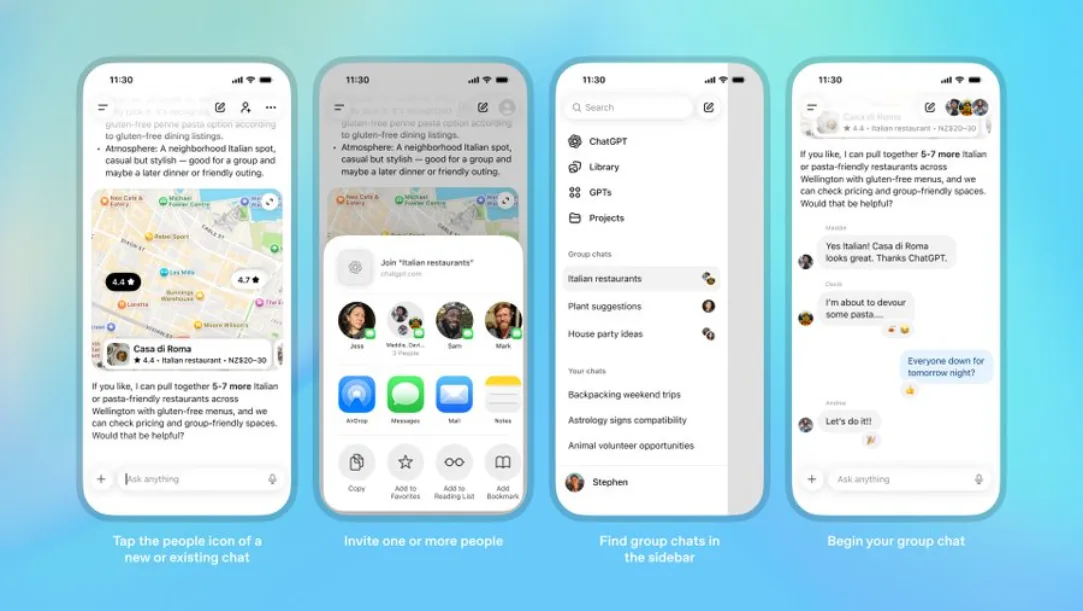
San Francisco: OpenAI has introduced a new WhatsApp-like Group Chats feature for ChatGPT, allowing users to collaborate in shared conversations with friends, family, or colleagues.
The update is currently in pilot mode and is available to Free, Go, Plus, and Pro users in select regions, including Japan, New Zealand, South Korea, and Taiwan.
How the Group Chats Work
The new feature lets up to 20 participants join a single conversation alongside ChatGPT. Hosts can invite members through a shareable link, and new participants are prompted to set up a short profile with their name, username, and photo.
The assistant responds using GPT‑5.1 Auto, ensuring smooth collaboration across multiple voices in the same chat.
Group chats in ChatGPT are now piloting in Japan, New Zealand, South Korea, and Taiwan.
A new way to collaborate with friends, family, or coworkers and ChatGPT in the same conversation. pic.twitter.com/UQKhqjcnQQ
— OpenAI (@OpenAI) November 14, 2025
Entertainment Meets AI Collaboration
OpenAI explained that the goal of Group Chats is to make ChatGPT more social and interactive. “With group chats, you can bring friends, family, or coworkers into a shared space to plan, make decisions, or work through ideas together,” the company said in its official announcement.
This makes ChatGPT function like a digital mediator, similar to WhatsApp, but with advanced AI capabilities such as summarizing discussions, generating images, and handling file uploads.
Stats and Rollout
The pilot rollout covers four countries initially, with plans to expand globally after feedback. Each group chat supports up to 20 people, and conversations are listed separately from private chats in the ChatGPT sidebar.
Importantly, personal ChatGPT memory is not shared with other participants, ensuring privacy within collaborative spaces.
Main Source
As reported by Mint, OpenAI’s ambitions of creating an “everything app” are becoming clearer with this launch. The company noted, “We expect to learn from early feedback and expand the feature to more regions in the future.”