
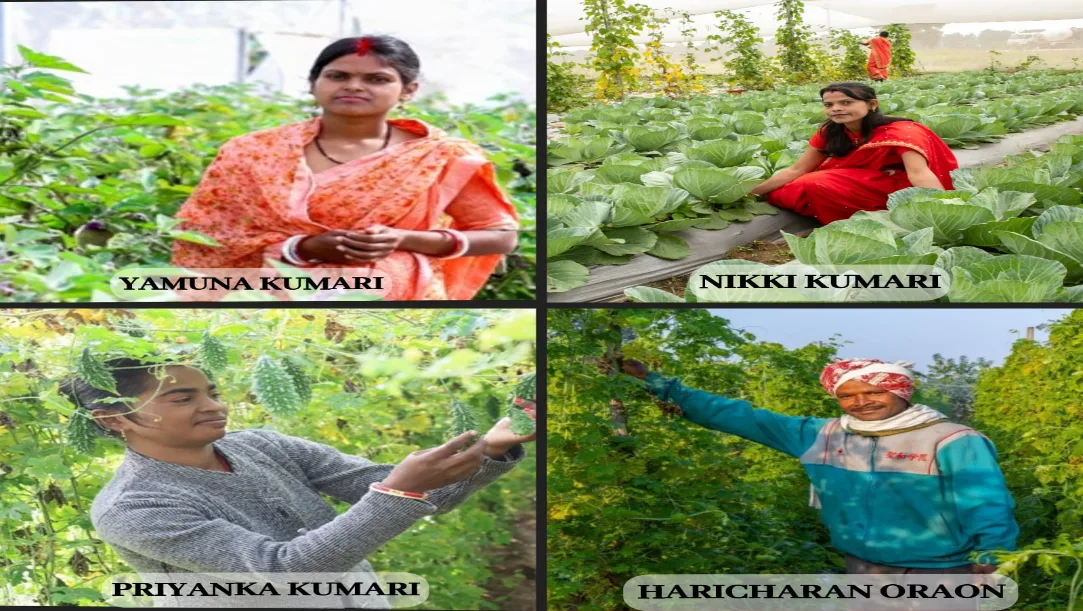
This Jharkhand Foundation Day, discover how four farmers are using modern, climate-resilient techniques to build secure and dignified livelihoods..
Rich in minerals and forest wealth, Jharkhand has abundant farming potential but is often challenged by erratic weather patterns including droughts and an unstable monsoon cycle. For many small and subsistence farmers, cultivation remains a daily struggle marked by low yields, fragmented land and outdated techniques.
But across these challenges, a quiet transformation is taking root. As Jharkhand celebrates its Foundation Day on November 15, it’s also a moment to celebrate its people.
Here are four stories of hope and regeneration. Through its work to transform India’s bottom 1,00,000 villages into thriving localities, Transform Rural India (TRI) has been part of this change.
By empowering farmers like Yamuna Kumari, Priyanka Kumari, Nikki Kumari, and Haricharan Oraon, TRI is helping Jharkhand’s communities increase productivity and earn dignified livelihoods.
An overview:
1. Yamuna Kumari
At just 23, Yamuna Kumari exemplifies the next generation of women farmers in Bero, Jharkhand. Married with two children, she had a postgraduate degree in Geography from KCB College, but was keenly interested in farming her five-acre land profitably.
Her family had till now grown only paddy, wheat, and vegetables, but with TRI’s help, Yamuna learnt new farming techniques at a Farmer Field School (FFS). She received hands-on training in polyhouse farming, nursery management, mulching, drip irrigation, root zone irrigation, and trellis systems.
She no longer struggles to sell her produce and is able to procure high-quality seeds. TRI also trained her in area selection, annual crop calendar making, crop selection, and best practices for fertiliser and manure application. She has also been provided access to a solar pump set, a training hall, and a nursery structure to experiment with new crops.
She now practices round-the-year farming, and has divided her land to grow a diverse range of crops such as mango, wheat, French beans, potato, grafted brinjal, marigold, cauliflower, green pea, ginger, green chili and strawberry, with additional crops during the Kharif season. She earns an annual income of approximately INR 10-11 lakh and as a successful ‘Mahila Kissan’ , is inspiring other farmers to also take up high-value agriculture.
2. Priyanka Kumari
Priyanka Kumari was a subsistence farmer who tirelessly worked to cultivate crops on her small, half an acre of land in Lipiya, Gola Block.
The traditional methods reliant on mercurial weather and local markets however were not making the most of the land’s potential. Seasonal irregularities, excessive rainfall or heat, pest attacks, and other assorted challenges like low yield resulted in a meagre annual income of just ₹20,000 to ₹21,000.
In 2022, TRI introduced her to modern techniques like greenhouse/protected farming, and she set up her first protected unit on six decimals of her land. She learnt to control pests naturally, improve soil health using organic methods, and gradually, her crops started flourishing and her income increased to ₹35,000–₹40,000 per season. Her success as a progressive farmer is also now paving the way for fellow farmers in her region.
3. Nikki Kumari
Nikki Kumari, a farmer from Purana Pani village in Bero Block, Ranchi District, had long relied on traditional farming practices on her 6–7 acres of cultivable land. However, the lack of scientific methods and poor crop planning meant her yields remained low, and she often missed opportunities to sell her produce at better market prices.
This inefficiency resulted in an annual income of around Rs. 3 lakh, leaving little room to support her family’s needs. In 2022, after learning about the Millionaire Farmers Development Programme (MFDP) at a CLF meeting, Nikki decided to embrace modern techniques.
Through the programme and with guidance from TRI, she was introduced to multi-tier farming, machan cultivation, protected farming, drip irrigation, and mixed cropping. She also learnt mulching and grafting techniques for crops like brinjal and tomato, and availed support through government schemes to install a solar lift irrigation system in her field. With improved irrigation and better crop planning, Nikki now earns Rs12–13 lakh per season.
Her success has enabled her to build a new home, buy a tractor, and provide her daughters with a quality education. Today, Nikki stands as an inspiration for farmers in neighbouring villages, showing how knowledge and innovation can transform lives.
4. Haricharan Oraon
Haricharan Oraon, a farmer from Dhurleta village in Rajadera Panchayat, Ranchi, once struggled to make a living from his small landholding. Coming from a poor family, he had to leave school early, and his family often relied on forest tubers to survive. In search of work, he spent nearly ten years in Punjab as a farm labourer before returning home to apply what he had learned.
In 2020, TRI introduced him to modern practices through MFDP, where he learnt about protected cultivation, creeper farming, soil-less nurseries, and drip irrigation, and soon set up his first net house on ten decimals of land.
His first cucumber cultivation fetched Rs 40,000, encouraging him to expand into capsicum, cauliflower, tomatoes, and leafy vegetables. Using multi-tier farming and organic methods, he now grows a mix of vegetables and fruits such as brinjal, chilli, beans, papaya, and mango.
Over time, his annual income has increased from Rs 2.65 lakh to Rs 10.75 lakh, ensuring financial stability for his family. Today, Haricharan stands as an inspiration in Dhurleta, where other farmers visit his fields to learn about modern, sustainable farming practices.
Explore more official announcements in our Press Release section.
