
This finding challenges long-held beliefs about the Moon’s oxygen-poor environment and suggests that meteorite impacts may have created localized oxidizing conditions.
Multiple sources confirm that hematite and maghemite crystals were identified in the regolith, reshaping our understanding of lunar chemistry and magnetic anomalies.
Iron rust in lunar soil samples
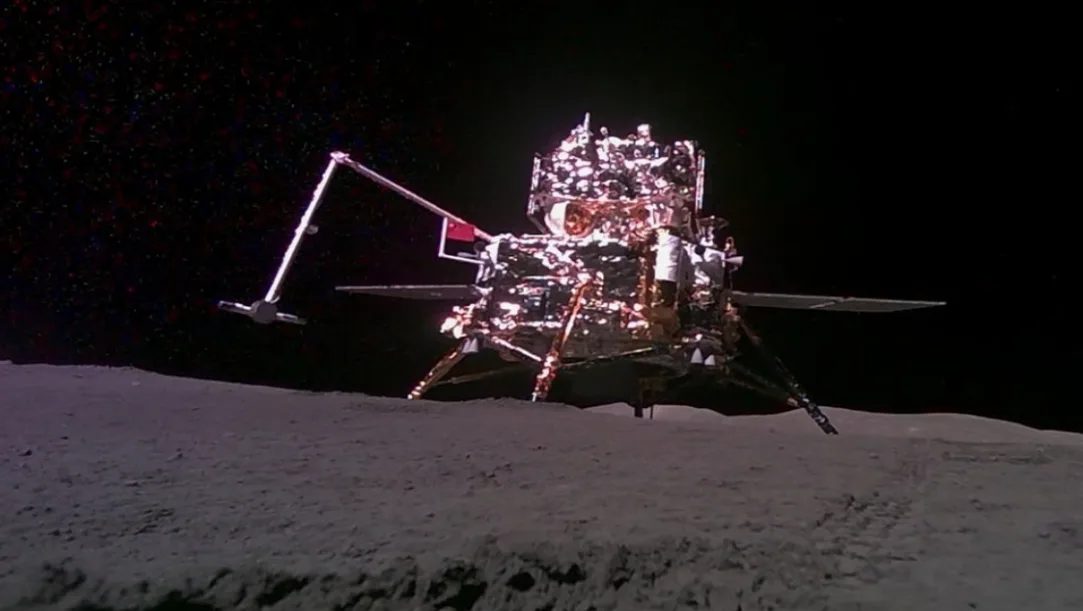
The Chang’e‑6 mission returned nearly two kilograms of samples from the South Pole–Aitken basin, a massive impact site stretching more than 2,500 kilometers across the lunar surface.
Researchers documented over 200 micrometer-scale grains containing hematite and maghemite, proving that oxidation is not a rare occurrence but a measurable process.
These oxides were found within breccias formed by meteorite collisions, while pristine volcanic fragments showed no signs of oxidation, confirming the link between impacts and chemical change.
Why the discovery matters
For decades, scientists believed the Moon’s surface was chemically reduced, making ferric minerals unlikely to survive.
Apollo-era reports of oxidized particles were often dismissed as contamination. However, recent missions have challenged this view.
In 2020, Chang’e‑5 samples revealed nanophase magnetite, and now Chang’e‑6 provides direct mineralogical evidence of hematite and maghemite.
This discovery suggests the Moon’s surface chemistry is more dynamic than previously thought, with meteorite impacts creating temporary oxygen-rich environments that allow iron particles to rust.
Expert insights and main source
“These oxides are intrinsic to the lunar soil, not artifacts,” one researcher explained, emphasizing that the grains were found within impact-bonded breccias.
According to the South China Morning Post, the findings could also help explain magnetic anomalies observed across the lunar surface.
The report highlights how shock heating during meteorite impacts may have released oxygen from sulfur-bearing minerals, allowing iron particles to oxidize and persist for billions of years.
Implications for future lunar exploration
The discovery of iron rust in lunar soil has major implications for future exploration. It suggests that the Moon’s surface is not chemically static and that oxidation processes could influence resource utilization strategies.
Understanding these reactions may guide future missions in identifying usable materials and deepen knowledge of planetary evolution.