
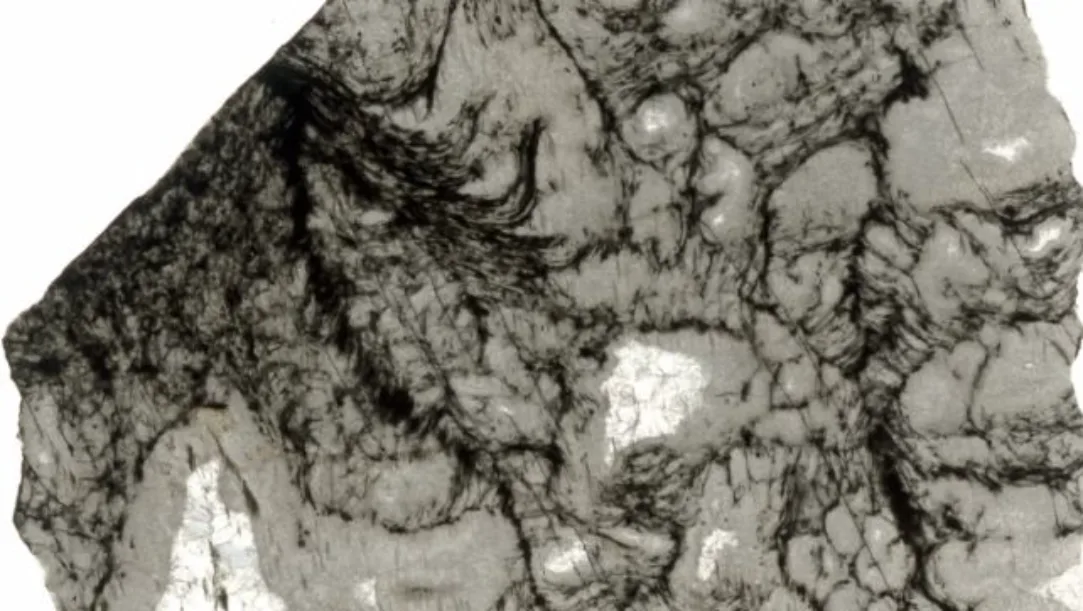
Scientists announced on November 17, 2025, a groundbreaking discovery that is fundamentally reshaping our understanding of life’s earliest emergence: the earliest chemical traces of life on Earth have been detected in a 3.3-billion-year-old rock from South Africa.
This noteworthy finding, achieved by pairing advanced chemistry with cutting-edge artificial intelligence, pushes back the verifiable timeline for life’s molecular signatures by nearly two billion years. For enthusiasts of paleobiology and the search for extraterrestrial life, this breakthrough offers a compelling new way to decode the “chemical echoes” left by the planet’s first microorganisms.
Researchers focused on ancient carbon remnants found within South Africa’s Josefsdal Chert, a sedimentary rock formation in the Mpumalanga province.
While the physical fossils of these earliest microbes are almost entirely destroyed by billions of years of geological heat and pressure, their molecular structure left a subtle, unique chemical fingerprint.
Therefore, the multidisciplinary team used a technique called pyrolysis-gas chromatography-mass spectrometry (Py-GC-MS) to break down the organic material and analyze its resulting fragments. However, interpreting these faint, degraded traces proved immensely challenging, which necessitated a high-tech solution.
Decoding Ancient Chemical Traces of Life with AI
To differentiate true earliest chemical traces of life on Earth from non-biological, or abiotic, material like meteorites or synthetic carbon, the scientists developed an innovative approach. They trained a supervised machine-learning model, specifically a “random forest” AI, on over 400 samples.
This extensive dataset included modern biological materials (like plants and animals) as well as ancient fossil remnants and non-living carbon-rich rocks. Consequently, the AI learned to recognize the subtle chemical patterns—the “biosignatures”—unique to life with an accuracy exceeding 90%.
Applying this robust model to the incredibly old rocks, the team achieved the earliest and most confident detection of biotic chemistry found on Earth to date in the 3.33-billion-year-old Josefsdal Chert.
Previously, such reliable molecular traces had only been found in rocks younger than 1.7 billion years, so this discovery approximately doubles the window of time scientists can study using preserved organic molecules.
In addition to this primary finding, the team also identified molecular evidence suggesting oxygen-producing photosynthesis was occurring in rocks dating back **2.52 billion years**—a massive extension of over 800 million years to that process’s known history.
The Broader Impact of Finding Earth’s Earliest Life
This study provides compelling evidence that ancient life leaves behind more than just physical fossils; it leaves durable chemical patterns. Robert Hazen, a mineralogist and astrobiologist from the Carnegie Institution for Science and a co-lead author, emphasized the importance of the new methodology.
According to Carnegie Science, Hazen stated, “Using machine learning, we can now reliably interpret these echoes for the first time.” Furthermore, this innovative technique has profound implications for the ongoing search for life beyond Earth.
Ultimately, the same AI-driven analysis of chemical patterns could be applied to samples from Mars or other planetary bodies, providing a powerful new tool in astrobiology to detect molecular “ghosts” of past organisms.
The research, published in the Proceedings of the National Academy of Sciences, demonstrates the remarkable resilience of these subtle chemical clues.
Scientists believe these first life forms were tiny microbes, and the fact that their molecular signatures survived over 3.3 billion years shows that the building blocks of life took root relatively quickly in Earth’s history, not long after the planet itself formed some 4.54 billion years ago.
