
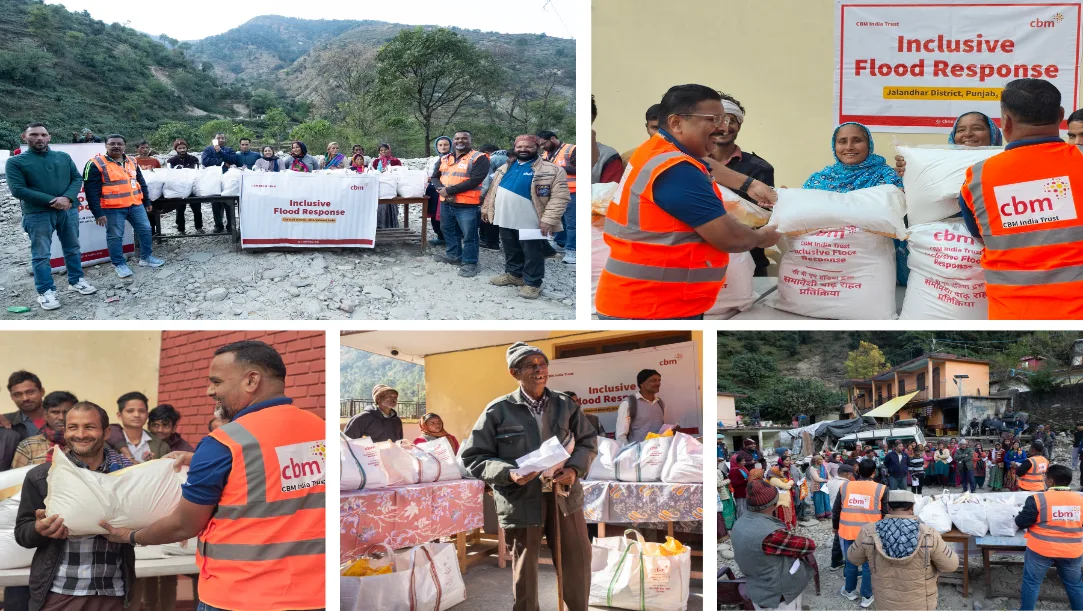
Building on its long-standing commitment to inclusive humanitarian action, CBM India has extended critical relief and recovery support to 2,000 families affected by the recent floods, landslides, and cloudburst in the Chamoli district (Uttarakhand) and Jalandhar district (Punjab).
The initiative focuses on post-disaster recovery and aims to ensure that the most marginalized, including persons with disabilities, women, elderly people, and children, can rebuild their lives with safety, dignity, and resilience.
Months after the disaster struck, many families in both states are still working to restore their homes and livelihoods. While relief efforts by the government and other agencies have been ongoing, communities continue to need support to recover fully.
CBM India’s intervention reinforces these ongoing efforts, providing inclusive assistance that helps people meet essential needs and restore normalcy.
CBM India distributed dry food and health and hygiene kits to 2,000 people. The kits contained essential food staples, such as wheat, rice, pulses, oil, and spices, as well as items like soap, toothpaste, sanitary napkins, and cleaning materials.
In the coming months, assistive devices will be provided to persons with disabilities to replace those lost or damaged in the disaster, reaffirming CBM India’s commitment to inclusion throughout the recovery process.
In addition, as part of the project, disaster management training will be conducted, covering topics such as post-disaster recovery, the role of communities as first responders, early warning systems, shelter management, search and rescue, first aid, and psychosocial well-being. All training is designed to ensure the inclusion and participation of persons with disabilities.
In the Chamoli district, the initiative will also support families across education, household recovery, and livelihoods. As the project moves forward, 250 children will receive school supplies and uniforms, ensuring they have what they need to stay engaged in their studies. Essential household items such as gas stoves, utensils, bedsheets, and blankets will be distributed to 125 families.
Other items to be supplied include tarpaulin sheets, solar lamps for areas with limited electricity, and warm clothing. A major focus of the project is on restoring livelihoods. CBM India will extend its support to 75 people through training and assistance to help them rebuild or initiate income-generating activities such as beekeeping, farming, and animal husbandry.
By supporting families to regain their means of earning and producing food, the program aims to help them recover more steadily and avoid slipping deeper into poverty.
Speaking on the initiative, Sony Thomas, Executive Director, CBM India, said, “Inclusive humanitarian action is at the core of CBM India’s work. While the immediate aftermath of a disaster often draws attention and resources, it is equally important to provide support that helps affected communities regain stability once the initial crisis has passed. Through this project, we’re helping families not only meet their essential needs but also rebuild their livelihoods and move toward a stronger, more secure future.”
This initiative reaffirms CBM India’s commitment to inclusive humanitarian action, spanning response, recovery, preparedness, and disaster risk reduction. Through its focus on accessibility and equity, CBM India supports communities to build back better and strengthen their ability to withstand future crises. The organization has a long history of inclusive relief efforts, responding to major disasters such as the Odisha super cyclone (1999), the Bhuj earthquake (2001), the tsunami (2004), the Kerala floods (2018), the COVID-19 pandemic, and cyclone Remal in West Bengal (2024). Over the past two years, CBM India has also been implementing a mangrove restoration project in the Sundarbans, where more than 30,000 saplings have been planted to strengthen the resilience of coastal communities.
Explore more official announcements in our Press Release section.
