
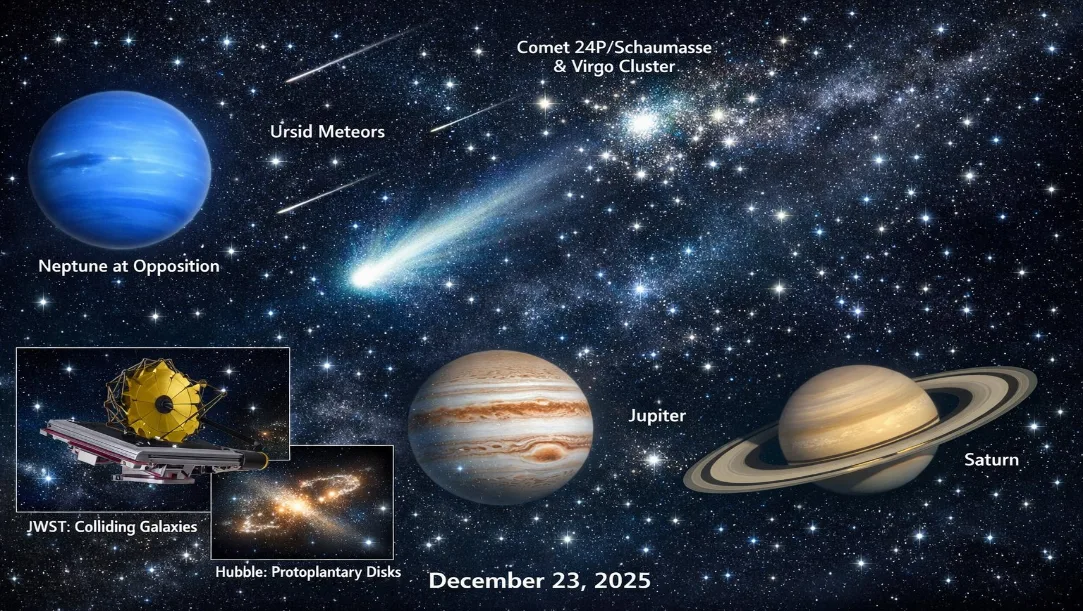
On December 24, 2025, the final celestial act of the year is reaching its conclusion as the Ursids meteor shower 2025 continues to offer subtle yet beautiful displays for patient stargazers. While the intense Geminids dominated the sky earlier this month with over 120 meteors per hour, the Ursids provide a more understated experience. This annual shower, which remains active from December 17 to December 26, is the perfect reward for those who enjoy the quiet solitude of the winter solstice season.
The Ursids are known for being a “minor” shower, typically producing roughly 5 to 10 meteors per hour. However, 2025 has provided an exceptional viewing window. Because a New Moon occurred on December 20, the nights surrounding the peak have featured almost perfectly dark, moonless skies. This lack of lunar interference allows even the faintest streaks of light—remnants of the periodic comet 8P/Tuttle—to become visible to the naked eye. Unlike the Geminids, which originate from an asteroid, these “shooting stars” are pure cometary dust burning up in our upper atmosphere.
Finding the Radiant: Ursa Minor and the North Star
To successfully spot the Ursids meteor shower 2025, observers should look toward the north. The shower’s radiant—the point from which the meteors appear to emerge—is located in the constellation Ursa Minor, popularly known as the Little Dipper. This area of the sky contains Polaris, the North Star, which remains fixed while the rest of the heavens seem to rotate around it. Because the radiant is circumpolar for most Northern Hemisphere viewers, it stays above the horizon all night long, offering a much larger window for observation than other seasonal showers.
Statistically, the best time to watch is during the predawn hours when the radiant sits at its highest point in the sky. During past events, the Ursids have been known to surprise astronomers with sudden outbursts of up to 100 meteors per hour, although 2025 has remained a steady and reliable display. According to The Guardian News, the unique satisfaction of this shower comes from witnessing one of nature’s subtler events, requiring a deckchair, several layers of warm clothing, and a significant amount of patience.
Viewing Tips for the Final Shooting Stars of 2025
If you are planning to head out for the final nights of the Ursids meteor shower 2025, preparation is key. Avoid looking directly at the radiant point; instead, scan the area about 30 degrees away from the Little Dipper. This technique allows you to see meteors with longer “tails” or paths across the sky. Furthermore, it is vital to avoid all light pollution, including the blue light from your smartphone, as your eyes require approximately 20 to 30 minutes to fully adjust to the darkness.
Consequently, the best viewing locations are rural areas or dark-sky parks away from city lights. As the Earth moves through the thinning debris field of Comet Tuttle over the next 48 hours, the frequency of sightings will gradually decrease. However, with the winter solstice having just passed, the long nights still provide ample opportunity to catch a stray shooting star. For many, the Ursids represent a peaceful end to the astronomical calendar, a moment of reflection before the Quadrantids take over in early January 2026.
Ultimately, the Ursids meteor shower 2025 is a reminder of our planet’s constant journey through the cosmic dust of the solar system. While it may lack the raw power of the summer Perseids or the winter Geminids, its reliability and the favorable moon phase this year make it a highlight for dedicated astronomers. Bundle up, find a clear patch of northern sky, and enjoy the final gift of the holiday night sky.