
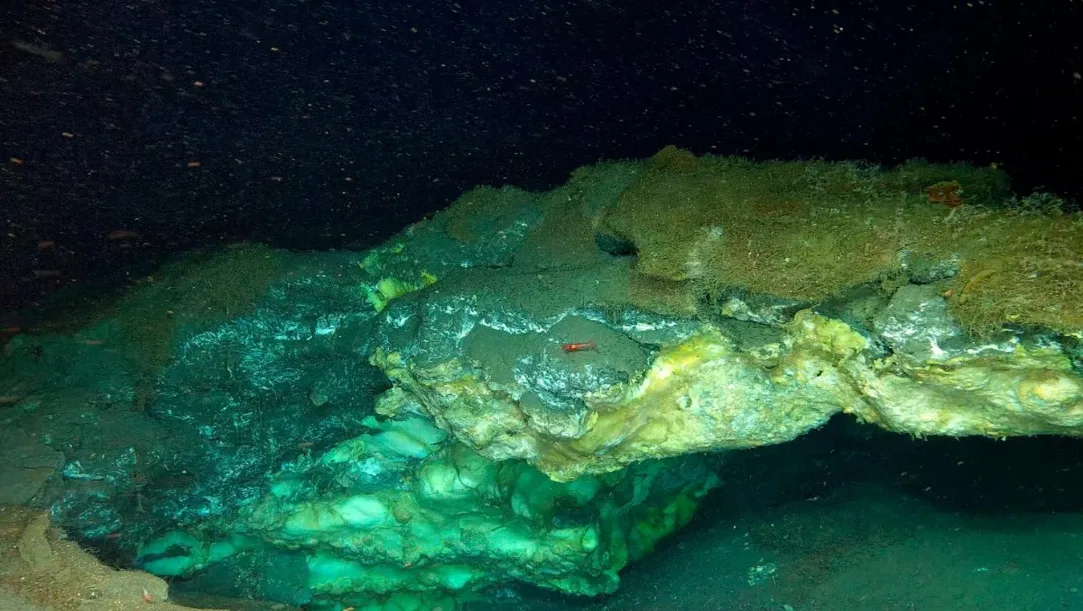
On December 25, 2025, oceanographers revealed that a bizarre ecosystem discovered more than two miles beneath the Arctic Ocean is home to life forms never seen before in such a harsh environment. At a staggering depth of 3,640 meters, researchers found massive mounds of frozen methane that act like “frozen reefs.” These structures support a thriving community of organisms in a region of the world that was previously thought to be a silent, underwater desert.
Transitioning into this deep-sea frontier, the team used advanced cameras to explore the Knipovich Ridge. They found that the water pressure at this depth is over 350 times greater than at the surface. Despite these crushing conditions and temperatures near 0°C, the bizarre ecosystem discovered there is teeming with activity. Scientists noted that the methane mounds are not just rocks, but living breathing hubs for specialized biology.
The Hidden Power of Methane Frozen Reefs
The scale of this environment is impressive, with some methane chimneys reaching heights of over 15 feet. Unlike coral reefs that rely on the sun, these reefs use chemicals. “We are looking at a world that doesn’t need the sun to survive,” remarked one lead researcher during the expedition. “This bizarre ecosystem discovered proves that life is much more resilient than we ever imagined.” This process, called chemosynthesis, allows bacteria to turn methane gas into food for larger animals.
In addition to the strange geological features, the sheer amount of life is surprising. Experts estimate that nearly 72% of the small organisms found around these vents could be entirely new to science. The site hosts a variety of creatures, including white “ghost” snails and thick mats of colorful bacteria. Because the area is so deep and cold, many of these animals grow very slowly and can live for decades or even centuries.
Scientific Breakthroughs in the Deep Arctic
This discovery provides a rare look at how gas trapped under the seafloor interacts with the ocean. According to Scientific American News, these mounds are “dynamic,” meaning they grow and change as gas leaks from the Earth’s crust. This movement creates a constantly evolving habitat. As one scientist put it, “It is like finding a tropical rainforest in the middle of a dark, frozen basement.”
Furthermore, the bizarre ecosystem discovered at 3,640 meters provides vital data for future space missions. Since the moons of Jupiter and Saturn have similar icy oceans, studying these Arctic reefs helps us understand where to look for alien life. As researchers continue to analyze the 500+ hours of video footage collected, it is clear that the deep Arctic Ocean still holds many more mysteries waiting to be solved. For now, this discovery stands as a powerful reminder of the vast, unexplored wonders of our own planet.