
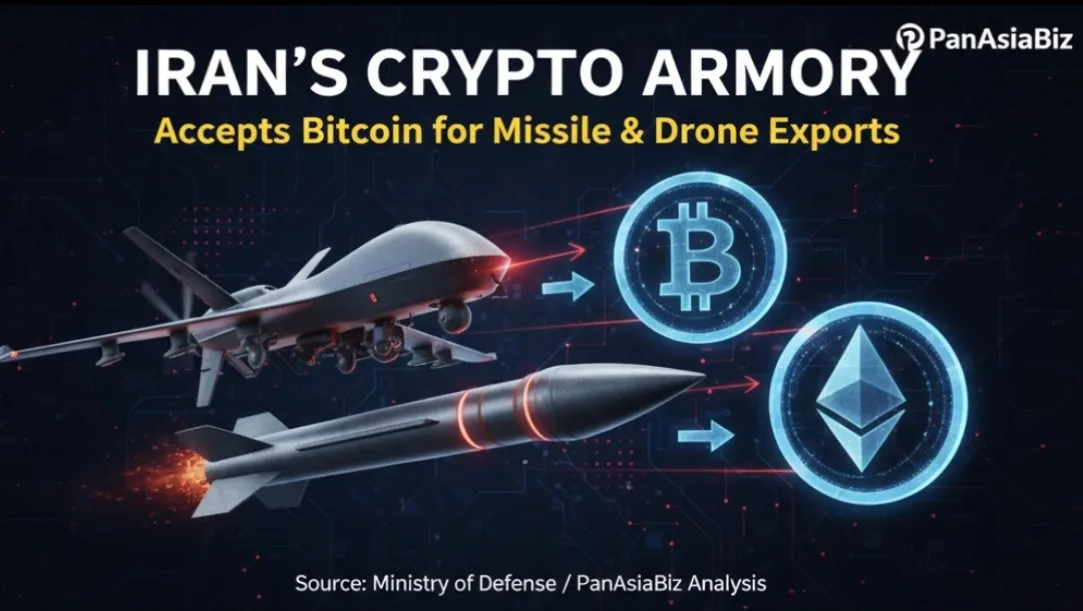
The global defense market is facing a paradigm shift as Iran enables crypto payments for advanced weapons exports to bypass tightening international financial restrictions. Mindex, the official export arm of the Iranian Ministry of Defense, recently updated its payment terms to allow foreign governments to settle military contracts using digital currencies. This historic policy change, which targets the sale of sophisticated hardware like the Emad ballistic missile and Shahed drones, became official on January 1, 2026.
Strategic Shift: Iran Enables Crypto Payments for Advanced Weapons Exports
The move to integrate blockchain technology into the defense sector aims to neutralize the impact of Western banking sanctions that have long hindered Tehran’s ability to receive foreign capital. By utilizing decentralized ledgers, the government can facilitate high-value transactions without relying on the SWIFT network or traditional dollar-clearing systems. Mindex currently maintains active trade relationships with 35 countries, offering a wide catalog of equipment including warships and short-range air defense systems. Integrating these digital assets allows the state-owned agency to promise uninterrupted contract execution regardless of external geopolitical pressure.
Financial analysts estimate that Iran has already utilized “shadow financial networks” to process over $100 million in Bitcoin for oil sales between 2023 and 2025. Extending this model to the arms industry represents a natural evolution of their sanctions-evasion strategy. According to an internal agency document, the use of digital currency is now a negotiable term alongside traditional barter arrangements and the Iranian Rial. “Given our national policy of circumventing sanctions, there is no issue in ensuring products reach their destination,” the agency stated on its official platform.
Global Implications of Crypto-Based Military Trade
International regulators are closely monitoring how Iran enables crypto payments for advanced weapons exports to assess the potential for increased regional instability. The ability to move millions of dollars in value instantly and pseudonymously could accelerate the proliferation of drone technology across different continents.
According to Financial Times News, this development marks one of the first times a nation-state has publicly endorsed cryptocurrency as a standard settlement method for lethal military hardware.
Recent reports suggest that the Iranian defense industry’s reliance on alternative payment methods grew by nearly 40% over the last fiscal year. Transitioning to a fully digital payment infrastructure could help the nation maintain its military-industrial complex despite high domestic inflation and currency devaluation. Furthermore, the focus on high-demand items like “kamikaze” drones ensures a steady stream of incoming digital assets from various overseas clients.
In conclusion, the news that Iran enables crypto payments for advanced weapons exports signals a new era of decentralized warfare financing that may challenge traditional global oversight mechanisms.
