
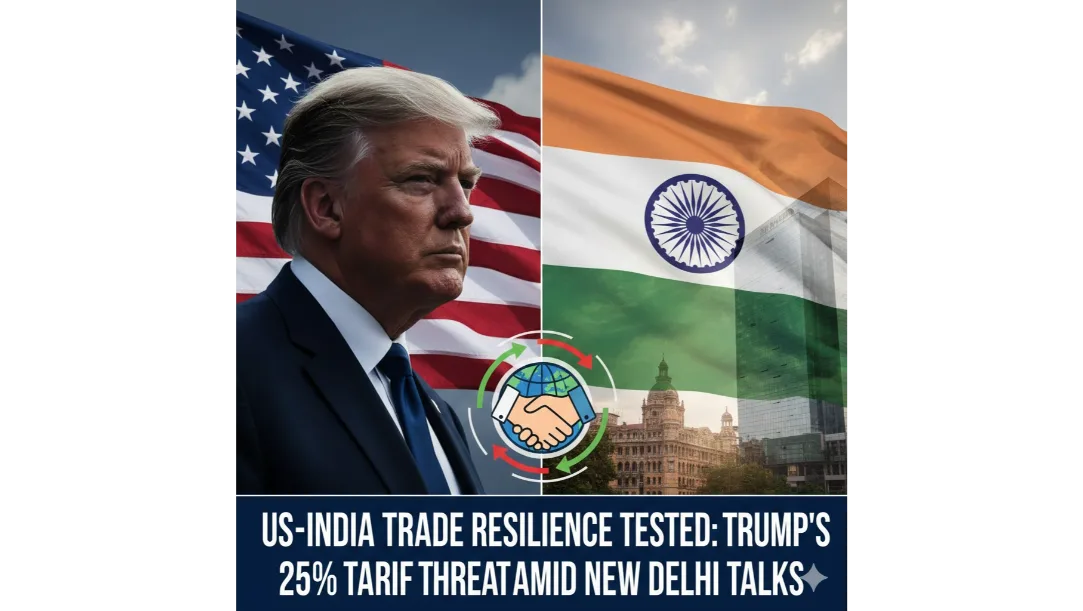
The high-stakes chess match between Washington and New Delhi took a dramatic turn today. Just hours after the newly appointed US Ambassador to India, Sergio Gor, described India as an “indispensable partner,” President Donald Trump threw a curveball that could see total US duties on Indian goods soar to a staggering 75%.
The ‘Iran Factor’ and the 75% Tariff Threat
In a “final and conclusive” order issued late Monday, President Trump announced an immediate 25% tariff on any nation conducting business with Iran. The move is aimed at isolating the Tehran regime amid escalating domestic protests.
For India, the timing is critical. Indian and US officials are scheduled to hold a trade call today, January 13, to resolve a long-standing impasse. However, this new “Iran layer” adds to an already heavy burden:
50% Base Tariff: Currently, many Indian exports already face a 50% duty (which includes a 25% penalty for India’s continued purchase of Russian oil).
The New 25%: If applied to India due to its deep trade ties with Iran (including the strategic Chabahar Port), the cumulative tariff could hit 75%.
Market Rebound vs. Diplomatic Friction
Despite the tariff threat, Indian equity markets showed resilience. The BSE Sensex and NSE Nifty 50 snapped a five-day losing streak on Monday, recovering over 1,000 points from intraday lows.
Investors appeared to be weighing the “Trumpian” pressure tactics against the optimistic signals from Ambassador Gor. Gor’s announcement that India would be invited to join PaxSilica—a US-led strategic silicon and semiconductor supply chain initiative—provided a much-needed boost to sentiment.
IT Sector in the Crosshairs: TCS and HCLTech Results
The trade volatility comes as India’s IT giants navigate internal and external shifts.
TCS: India’s largest IT firm reported a 14% drop in annual net profit for Q3 FY26. The bottom line was weighed down by ₹2,128 crore in one-time costs related to India’s new labor codes and legal provisions.
HCLTech: In contrast, HCLTech outperformed expectations, raising its growth guidance for the full year and signaling that demand for AI-led transformation remains robust despite the “tariff shadow.”
The Veteran’s Take: A Test of Sovereignty
As a veteran observer of these markets, it is clear that Washington is using trade levies as a primary tool of diplomacy. For New Delhi, the challenge for 2026 is maintaining economic sovereignty—specifically its energy ties with Russia and strategic projects in Iran—without losing access to the massive American market.
Today’s trade call will be more than just a negotiation; it will be a defining moment for the “most consequential global partnership of this century.”
