
These models offer scalable lessons for the nation’s broader development with grassroots action and local solutions
Long before India’s independence, ‘Gram Swaraj’ – the idea of self-reliant villages was envisioned by Mahatma Gandhi. “The soul of India lives in its villages,” he stated to emphasise that rural development is central to the progress of the nation.
He hoped that as a democratic republic, India would empower rural regions with a self-governing approach promoting economic independence, local resource utilisation, social justice, and decentralization. As the nation celebrates the 77th anniversary of the adoption of the Constitution of India, Gandhi’s idea of rural Sarvodaya (Welfare of All) continues to live in the strength and dignity of India’s villages.
Through community leadership, infrastructural improvements and entrepreneurial growth, villages are becoming active participants in the nation’s economic growth. Here are three examples of rural models that offer scalable lessons for broader development with grassroots action and local solutions.
1. Neighbourhoods of Care
Development design organisation Transform Rural India’s (TRI), which has been working for over a decade to transform India’s bottom 1,00,000 villages into flourishing localities, describes Neighbourhoods of Care (NoC) as a community-centered public health model that redefines how health and wellbeing are sustained in rural India. It builds localized ecosystems of care that connect families, communities, and public systems, ensuring health ownership at every level.
This concept recognizes that some health problems cannot be solved by medication or clinical interventions alone and that people need more holistic and personalized care that integrates considerations of the social and ecological factors determining their ability to live a healthy life. It coalesces the network of private players, women collectives such as SHGs, healthcare providers and others to work towards health equity for all.
By empowering citizens to manage their own care through home, community, and facility support networks, NoC aims to address systemic health gaps, mitigate mortality rates, tackle communicable and non-communicable diseases and in turn aims to strengthen India’s public health architecture.
In a scenario where ‘facility-based’ care does not always promise timely access to emergency support or healthcare experts, NoC has emerged as the critical force at the centre of rural Indian healthcare by building the collective capacity of neighbourhoods. Now local community collectives, panchayats and the frontline workers, are helping to ensure that place-based needs are met and rural Indians can access services and tools needed for holistic well-being.
2. Lado Panchayat
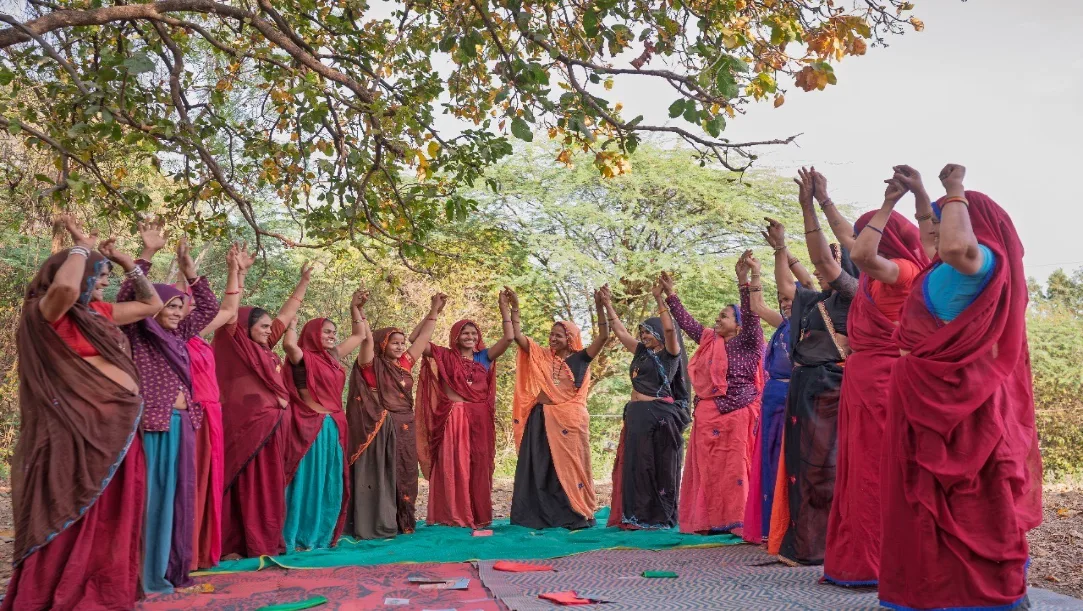
National Crime Records Bureau (NCRB) data has frequently offered data indicative of spiralling crimes against women. Against this backdrop of gender crimes ranging from rape, dowry deaths, domestic violence, acid attacks and more, a women-led grassroots governance initiative is fearlessly challenging patriarchy and discrimination. Lado Panchayat not only strengthens rural women’s roles in local decision-making but offers them a safe space to push back against practices like child marriage.
Lado Panchayat is directly impacting rural governance and has put the spotlight on the widely prevalent practice of “sarpanch pati” where male relatives usurp the power of elected women in panchayats. In 2021, Lado Panchayat campaigned to raise the legal marriage age for girls to 21 though this bill is still under consideration.
Other outreach and advocacy efforts include meetings to discuss issues, propose solutions and demand stricter laws for the protection of women. Lado Panchayat also routinely addresses micro aggressions, abusive, casteist and gendered language. In 2022, its work was presented to an Indian parliamentary committee, highlighting the power of tireless advocacy.
3. MYRADA (Mysore Resettlement and Development Agency)
Since its inception in 1968, The Mysore Resettlement and Development Agency (MYRADA) have emerged as a pioneering non-government organisation that now works with more than a million families in 18 districts of Karnataka, Andhra Pradesh and Tamil Nadu.
Apart from working to improve health and education markers, MYRADA synergises with governments and other partners to influence policy making in favour of the underserved. It empowers community-based organisations (CBOs) to create livelihood opportunities and manages as well as develops natural resources in underserved regions.
From supporting the resettlement of Tibetan refugees in the late sixties, MYRADA has come a long way and is now known for path-breaking micro-finance and sustainable rural development initiatives too. In fact, MYRADA has been instrumental in shaping the Self-Help Group (SHG) movement’s evolution and has worked diligently to integrate informal workers into the formal financial system.
The organisation has helped to address economic disparities, encouraged financial inclusion of especially women and transformed countless SHGs into thriving, self-reliant institutions.
Founded in 2016, Transform Rural India works alongside rural communities to advance inclusive development rooted in local leadership. As it enters its second decade in 2026, TRI is deepening its gender-intentional approach while scaling community-led models to drive equitable and sustainable change across rural India.
