
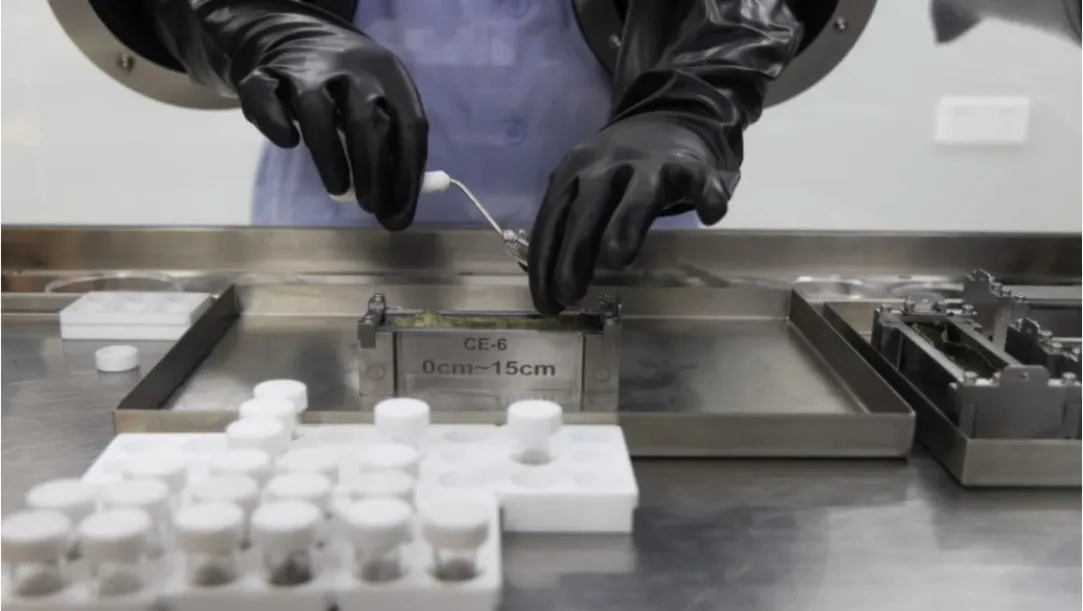
Chinese scientists have identified meteorite remnants in Chang’e-6 lunar samples, offering fresh insights into the origin of water on the moon and how materials move across the solar system. The findings were announced by the Chinese Academy of Sciences (CAS) on Tuesday.
Chang’e-6 Meteorite Remnants: A Window into the Past
The study, published in the Proceedings of the National Academy of Sciences (PNAS), reveals that fragments from rare CI carbonaceous chondrites—meteorites rich in water and organic matter—were found in the moon’s soil. These meteorites account for less than 1% of those found on Earth, but surprisingly make up nearly 30% of the lunar meteorite record.
“The moon acts as a natural archive,” said Xu Yigang, lead researcher from the Guangzhou Institute of Geochemistry. “Unlike Earth, it lacks an atmosphere and geological activity, preserving impact traces for billions of years.”
How Meteorites May Have Delivered Water to the Moon
According to the CAS team, the olivine-bearing fragments in the samples formed when the parent body of the CI meteorites struck the lunar surface, melted, and then rapidly cooled. These impacts may have introduced water and organic compounds to the moon, explaining the presence of positive oxygen isotopes in previously analyzed lunar water samples.
Implications for Solar System Evolution
This discovery supports the theory that material from the outer solar system can migrate inward. The parent asteroids of CI chondrites are located far beyond Mars, yet their remnants are now found on the moon—suggesting dynamic material transfer across planetary boundaries.
“This expands our understanding of the Earth-moon system and the broader solar system,” Xu told Global Times.
Technical Breakthroughs in Lunar Analysis
The team developed a systematic method to identify exogenous (non-lunar) materials in moon soil, combining petrographic analysis with trace element and isotope studies. This marks a major leap in extraterrestrial sample research.
In 2024, the Chang’e-6 mission returned 1,935.3 grams of lunar soil from the South Pole-Aitken Basin—the oldest and deepest crater on the moon. Xu’s team received the samples in August and completed their analysis in just five months.
As China continues to lead in lunar exploration, the Chang’e-6 meteorite remnants discovery could reshape how scientists view the moon’s history and its connection to the solar system. More revelations may follow as deeper layers of lunar soil are analyzed.
