
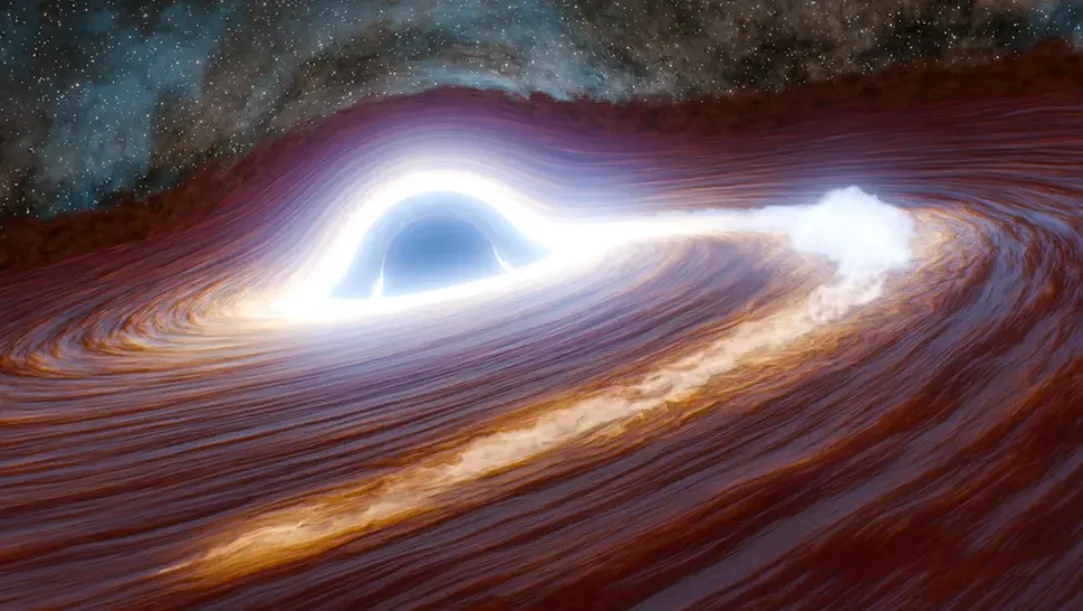
Scientists have detected the biggest black hole flare ever seen, radiating with the staggering power of 10 trillion suns.
This cosmic burst, spotted by the Zwicky Transient Facility (ZTF), is not only the brightest but also the most distant flare ever recorded, located 10 billion light-years away from Earth.
Biggest Black Hole Flare Ever Seen Stuns Astronomers
According to Space.com, the flare erupted from a supermassive black hole at the center of an Active Galactic Nucleus (AGN) named J2245+3743. These AGNs are regions in galaxies where black holes actively consume surrounding matter, creating intense energy bursts.
Meanwhile, CBS News reports that the flare was first observed in 2018 and took nearly three months to reach peak brightness. The flare’s light traveled across 10 billion light-years, offering a glimpse into the early universe.
Power of 10 Trillion Suns: A Cosmic Benchmark
Notably, this flare is estimated to shine with the energy equivalent of 10 trillion suns. To put that in perspective, our Sun produces about 3.8 x 1026 watts of power. Multiply that by 10 trillion, and you get a cosmic event of unimaginable scale.
“It’s like a fish only halfway down the whale’s gullet,” said one researcher, describing how the black hole is still in the process of consuming the star that triggered the flare.
What Caused the Black Hole Flare?
Scientists believe the flare was caused by a massive star being shredded by the black hole’s gravitational pull. As the star’s material spiraled into the black hole, it formed an accretion disk — a swirling cloud of gas and dust — which ignited the flare.
According to Caltech Astronomy, this event helps researchers understand how black holes grow and interact with their host galaxies. The flare also offers clues about the behavior of magnetic fields and gas dynamics around black holes.
Why This Discovery Matters
This record-breaking flare is more than just a cosmic light show. It provides valuable data for astronomers studying the evolution of galaxies and the role of supermassive black holes in shaping the universe. Additionally, it highlights the capabilities of modern observatories like ZTF and the Palomar Observatory in capturing transient cosmic events.
