
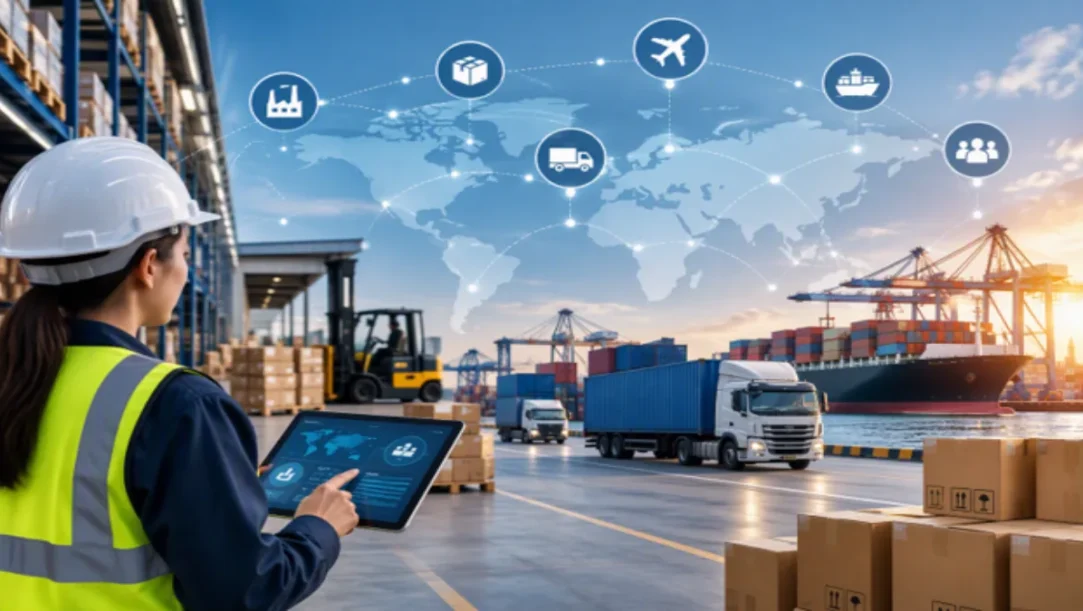
The field of supply chain management is rapidly advancing due to technological progress and the interconnectivity of today’s enterprises. The tasks that include procurement, inventory management, logistics, demand prediction, and supplier management are becoming more and more technologically dependent.
In this respect, artificial intelligence (AI) and data analytics have become an integral part of this evolution, because these technologies allow businesses to interpret complicated information, analyze and visualize supply chain processes. This revolution means new jobs for people working in the field that require a combination of practical knowledge and technological competence.
Instead of eliminating supply chain specialists, AI is changing the way they perform their job duties.
The Growing Role of AI in Supply Chain Management
The supply chain management course create information in nearly all processes involved in the business. It becomes quite difficult for the manual management and interpretation of this information, especially when the organization needs to act on the spot.
AI can help professionals in analyzing data, finding patterns, and identifying the issues that require focus. This helps the supply chain team to spend less time on process-oriented activities and more on decision-making and problem-solving.
AI can support several areas of supply chain management, including:
- Demand planning and forecasting
- Inventory management
- Procurement and supplier analysis
- Logistics and transportation planning
- Operational decision making
For professionals, understanding how AI contributes to these areas can become an important part of building relevant skills for modern supply chain roles.
Data Analytics Is Making Decisions More Informed
Data analytics is also affecting how professionals make their decisions.
In the past, supply chain decisions were often made based on information from the past and experience. However, modern professionals have the ability to use data analytics to get more information about their performance and business needs.
For example, analytics will aid professionals in comprehending how their inventories move, what their buying trends are like, the details of suppliers, and the demands of customers. The above information can be used in decision making in various aspects of the supply chain.
It also alters the skills that employers place value on. Supply chain management professionals are now in greater need of understanding how to analyze data and draw valuable conclusions based on it.
Demand Planning and Inventory Management Are Becoming Smarter
Demand understanding is the biggest task in supply chain management. It is important for businesses to make sure that the products and raw materials are available when needed without building up excess inventory.
Artificial Intelligence (AI) and data analytics may assist people in getting more visibility with respect to demand patterns and evolving needs. Rather than depending solely on the conventional way of planning, one can take advantage of the available information.
This shift requires those working in the fields of demand planning and inventory management to not only understand operations but also possess analytical skills.
That means being able to analyze and understand what the data means and why things are happening, and then taking action based on that analysis.
Procurement and Supplier Management Are Changing
The other sphere where artificial intelligence and analytics play an essential role for career development is procurement.
Those who work in the sphere of procurement usually have to analyze data related to suppliers, purchasing needs, costs and priorities in the company. Analytics is helpful here to structure and analyze the data, and AI will assist to spot patterns.
But, of course, the full automation is not possible.
Supply chain professionals still need to:
- Communicate effectively with suppliers and internal teams
- Understand business and operational requirements
- Evaluate information before making decisions
- Build productive supplier relationships
- Connect procurement decisions with wider business goals
This combination of technology knowledge and human judgment is becoming increasingly valuable.
New Skills Are Becoming Important
With increased technologization of supply chains, one may require developing skills beyond just logistics and operations expertise.
Data analysis is now becoming very necessary because professionals require that data be interpreted properly.
The process of analytical thinking enables professionals to spot patterns, assess situations, and tackle operational problems.
Technology awareness enables experts to understand how AI, analytics, and digital technologies may help in carrying out supply chain functions.
Strategic thinking enables linking the operational supply chain management activities to the overall organizational objectives.
At the same time, communication and collaboration remain important because supply chain professionals frequently work across different functions and with multiple stakeholders.
Career Opportunities Are Becoming More Diverse
Career options are also getting expanded with the evolution of supply chains. People can follow their careers in more conventional domains like procurement, logistics, operations, demand planning, and inventory management. But with the increased application of technology, there is a growing interest in jobs related to analytics, digital operations, and supply chain evolution. An IIM Supply Chain Management course will be useful in acquiring necessary skills for these emerging career options.
This provides scope for professionals who are seeking ways of moving from their operational roles to something that is more analytical and involves strategy formation.
However, this would also imply that mere technological skills may not suffice. Professionals who have knowledge of the operations of the supply chain and of the capabilities of AI and analytics may stand a better chance.
Human Skills Still Matter
While the role of AI is becoming increasingly prominent, the role of humans in supply chain management cannot be overlooked.
Technology may help us analyze data and detect patterns, but it is ultimately up to the humans to interpret the context behind this data and make business-related decisions.
Critical thinking, communication, flexibility, and problem-solving will continue to be significant. The professionals need to know when to believe data, when more investigation is required, and when to share information with others.
The future of supply chain careers is not simply about becoming more technical. It is about combining technology with strong business understanding and human judgment.
AI and data analytics are changing supply chain management from an operationally focused function into an increasingly intelligent and insight driven area of business.
Today, professionals are supposed to not only learn about conventional processes in supply chain but also feel at ease with analytics, artificial intelligence and digital technology. This means that certain skills like data analysis, strategic thinking, problem-solving, and communications will be even more important in the future.
The developments offer an opportunity for students and working professionals to enhance their skill sets in terms of combining business, technological, and analytical skills. The integration of AI and data analytics into the supply chain does not only change how the supply chain works but how the professionals involved can leverage their skills.
Related posts:
 Exploring the Complicated Business of Protecting Data During a Company Merger
 Emirates NBD Partners with Dubai Future District Fund to Drive FinTech and AI Innovation
 KDEM Delegation Meets G Parameshwara to Drive Karnataka’s Digital Future
 SSK Student Career Counselling 2026 to Guide Students on Subject Choices
 Boehringer Ingelheim Surveys 335 Professionals to Chart a Sustainable Future for SEA Veterinary Medicine
 The Folding Future: Samsung Stuns CES 2026 With Galaxy Z Tri-Fold Debut

Leave a Reply