
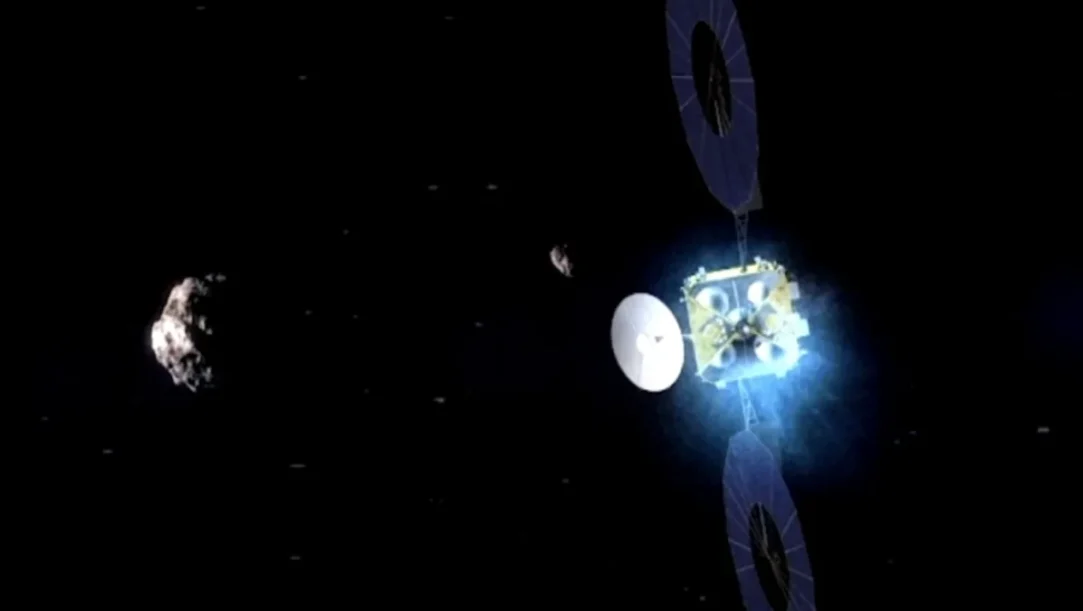
We dug into what this rendezvous means for asteroid science and China’s growing space ambitions.
A Small Rock With a Big Mystery
Kamo’oalewa measures just 50 to 65 feet across. It’s tiny. But scientists suspect it might actually be a chunk of our own Moon, blasted into space by an ancient impact.
Tianwen-2 first detected the asteroid on June 6, then closed the gap step by step. It reached 30,000 kilometers out on June 7, tightened to 2,000 kilometers by June 19, and finally settled just 20 kilometers from the surface on July 2.
Sara Russell of the London Museum of Natural History called it “an amazing achievement” to reach and observe such a small object.
What Happens Next
The probe carries 11 scientific instruments. Cameras, spectrometers, radar, and a magnetometer will map Kamo’oalewa’s surface for nearly a year.
Engineers will then attempt to collect 20 to 100 milligrams of material using one of three sampling methods. Tianwen-2 is scheduled to depart the asteroid around April 24, 2027, and drop its sample capsule to Earth by late November 2027.
China's Tianwen-2 spacecraft photographed Kamoʻoalewa, Earth's temporary "quasi-moon." Measuring just 50 to 65 feet wide, the asteroid orbits the Sun in sync with Earth. Scientists hypothesize it may actually be a chunk of our Moon knocked into space by an ancient impact
— I-AM-RAAJ🐦 (@raaj_hydb) July 11, 2026
Beyond the Quasi-Moon
After the sample return, Tianwen-2 won’t come home. Instead, it heads toward comet 311P/PANSTARRS in the main asteroid belt, with arrival set for January 2035.
Kamo’oalewa is one of only seven known Earth quasi-satellites. Its orbit has lasted roughly 100 years already and should continue for another 300, according to The Planetary Society.
Related posts:
 Malaysia and Indonesia Issue Historic Ban on Musk’s Grok AI
 Expo 2025 Osaka Ends with 29 Million Visitors: ‘Myaku-Myaku’ Mascot and Yumeshima Legacy Celebrate Historic 184-Day Run
 Moon Mystery Solved: Chinese Team Finds Iron Rust in Lunar Soil
 Chang’e-6 Meteorite Discovery Sheds Light on Moon’s Water Origins and Solar System Dynamics