
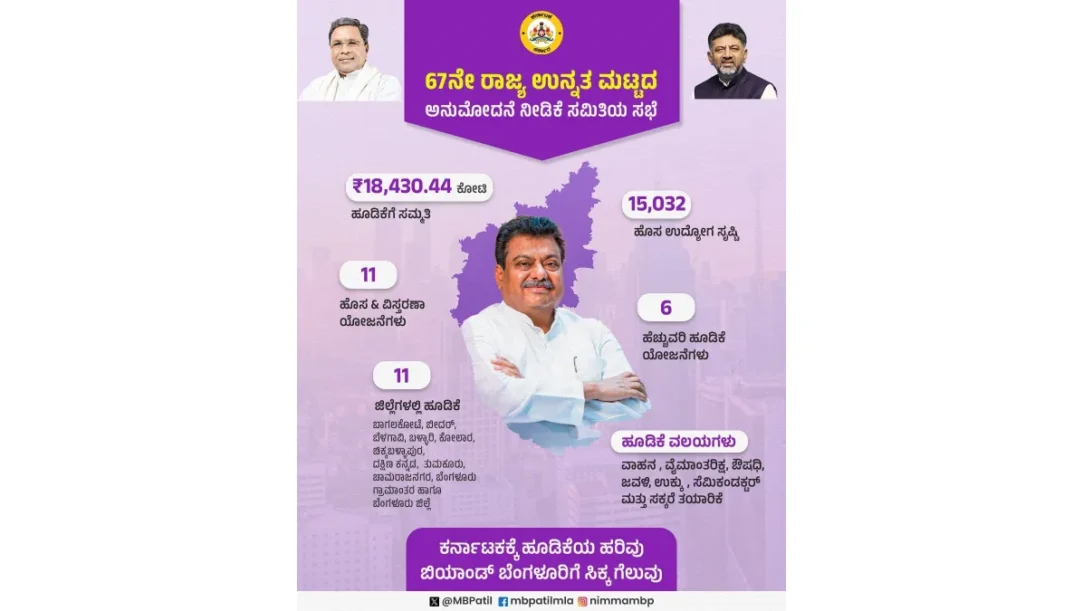
BENGALURU – In a substantial boost to its industrial landscape, the Karnataka government has cleared 17 investment proposals worth ₹18,430.44 crore. This latest round of approvals is expected to create at least 15,032 new jobs across the state.
The decision was finalized during the 67th meeting of the State High-Level Clearance Committee (SHLCC). The approved projects include 11 brand-new ventures and 6 expansion projects from existing companies.
Strengthening the “Beyond Bengaluru” Vision
A key highlight of this investment cycle is the geographical distribution of the projects. Minister for Large and Medium Industries, M.B. Patil, shared the news via social media, emphasizing that the state’s strategy to decentralize industry is yielding results.
“These investments are being spread across 11 different districts. This is a clear indication that our ‘Beyond Bengaluru’ concept is taking firm root in the industrial sector,” Minister Patil stated.
By encouraging companies to set up units outside the capital city, the government aims to ensure balanced regional development and reduce the infrastructural pressure on Bengaluru.
ಕರ್ನಾಟಕಕ್ಕೆ ಹೂಡಿಕೆ ಹರಿವು
ಬಿಯಾಂಡ್ ಬೆಂಗಳೂರಿಗೆ ಸಿಕ್ಕ ಗೆಲುವುಕರ್ನಾಟಕಕ್ಕೆ ಮತ್ತೆ ₹ 18,430.44 ಕೋಟಿ ಮೊತ್ತದ ಬಂಡವಾಳ ಹರಿದು ಬಂದಿದೆ. ರಾಜ್ಯ ಉನ್ನತ ಮಟ್ಟದ ಅನುಮೋದನೆ ನೀಡಿಕೆ ಸಮಿತಿಯ 67ನೇ ಸಭೆಯಲ್ಲಿ 11 ಹೊಸ ಹಾಗೂ 6 ಹೆಚ್ಚುವರಿ ಬಂಡವಾಳ ಹೂಡಿಕೆಯ ಯೋಜನೆಗಳಿಗೆ ಸಮ್ಮತಿ ನೀಡಲಾಗಿದ್ದು, ಇದರಿಂದ ರಾಜ್ಯದಲ್ಲಿ ಹೊಸದಾಗಿ… pic.twitter.com/0yzlSXvEaf
— M B Patil (@MBPatil) April 15, 2026
Impacted Districts and Key Sectors
The new projects will be implemented across a diverse range of districts, spanning from Northern Karnataka to the Old Mysore region:
- North & Central Karnataka: Bagalkot, Bidar, Belagavi, and Ballari.
- Southern Karnataka: Kolar, Chikkaballapur, Tumakuru, and Chamarajanagar.
- Coastal & Capital Region: Dakshina Kannada, Bengaluru Rural, and Bengaluru Urban.
Economic Outlook
This massive capital inflow reinforces Karnataka’s position as a preferred destination for both domestic and global investors. By focusing on 11 different districts, the state is not only creating local employment for rural youth but also improving the industrial ecosystem in Tier-2 and Tier-3 cities.
Industry experts suggest that the mix of new and expansion projects shows high investor confidence in Karnataka’s policy stability and ease of doing business. As these 17 projects move toward implementation, they are expected to spark a secondary wave of economic growth in the supporting MSME sectors within these districts.
Related posts:
 India’s First Tech Museum to Rise in Bengaluru: Karnataka Aims for Global Innovation Hub
 Lancaster University to Launch Bengaluru Campus in Major Higher Education Boost
 Gangadhar Muttagi Secures 0.5 & 3.5 Ranks in K-CET 2026 Out of 2 Lakh Students
 ‘Mysore Sandal’ Hits Record ₹2,016 Crore Turnover and ₹507 Crore Profit
 Dharwad MLA Aravind Bellad Welcomes TVS ILP’s ₹200 Crore Investment, Calls for North Karnataka Inclusion
 Karnataka Congress Government Grants ₹14.46 Crore to 73 Kalyana Karnataka Startups
 MB Patil Approves ₹4,824 Crore Investment for 14,500 New Jobs in Karnataka
 1 Crore Safety Net: Karnataka Congress Protects 100% of Forest Staff With Massive Insurance Boost