
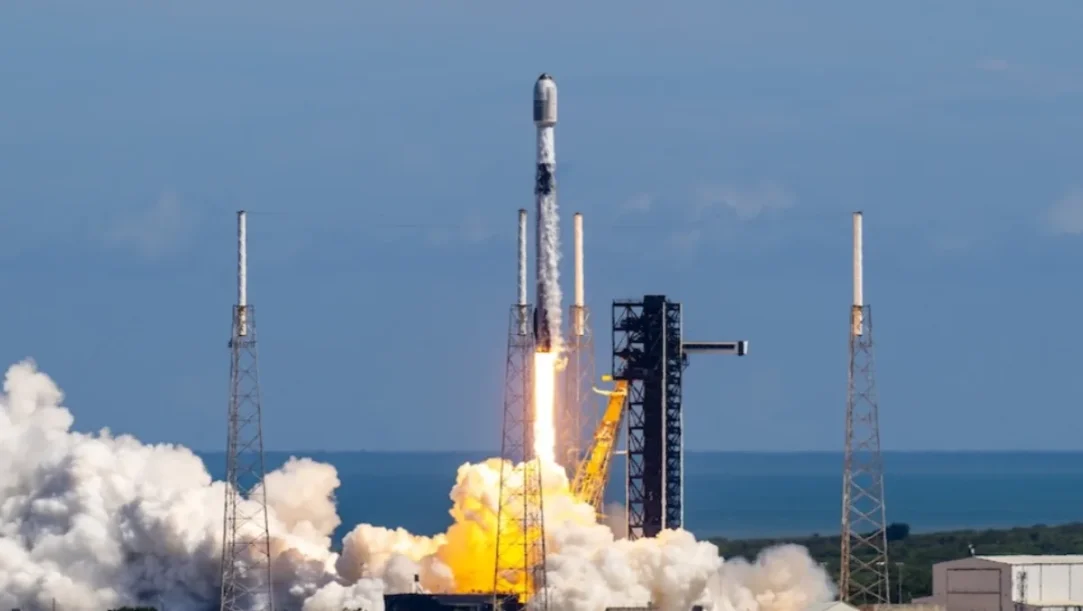
SpaceX launched two Falcon 9 rockets from opposite coasts of the United States just 38 minutes apart Saturday night, setting a new company record for the shortest gap between orbital missions.
The back-to-back liftoffs aren’t just a stunt for space nerds. They’re a real signal of how fast SpaceX’s launch machine has gotten — a cadence no other rocket company on Earth currently comes close to matching, and one that’s reshaping how satellite operators and the Pentagon plan their own timelines around SpaceX’s schedule.
The first Falcon 9 lifted off from Cape Canaveral Space Force Station in Florida at 9:12 p.m. EDT, carrying eight satellites for Louisiana-based telecom company Globalstar into low Earth orbit. All eight deployed successfully, SpaceX said, separating from the rocket’s upper stage over roughly six minutes, starting about 56.5 minutes after launch.
Then, just 38 minutes and 31 seconds later, a second Falcon 9 thundered off the pad at Vandenberg Space Force Base on California’s central coast. That rocket carried a classified payload for the U.S. Space Force, known only as USSF-366. Neither SpaceX nor the Space Force has said what’s actually aboard it.
Both boosters stuck their landings. The Florida rocket, booster B1090, flew its 14th mission and touched down at Landing Zone 40 about eight minutes after liftoff. The California booster, flying its 18th mission, landed on the droneship “Of Course I Still Love You” in the Pacific roughly 8.5 minutes after launch — pushing SpaceX’s all-time tally of successful booster landings past 650.
Liftoff! pic.twitter.com/8Mbybg8lcx
— SpaceX (@SpaceX) August 16, 2026
Rocket trackers have their own theories about the secretive California payload. NextSpaceflight.com wrote in its mission notes that the satellites may be built on SpaceX’s Starshield bus — a hardened, military-grade version of the Starlink satellites that make up the company’s broadband constellation — based on where the rocket’s spent stages are expected to fall.
Saturday’s doubleheader smashed SpaceX’s previous best, a 65-minute gap between two Starlink missions set back on August 31, 2024. Shaving 27 minutes off that record in under two years says something about how routine orbital launches have become for the company.
The two missions also pushed SpaceX’s 2026 Falcon 9 tally to 96 launches so far this year, with Starlink missions making up roughly three-quarters of that total. With SpaceX now operating nearly 11,000 Starlink satellites in orbit — the largest satellite constellation ever built — analysts expect the company’s launch pace to keep climbing before the year is out.
