
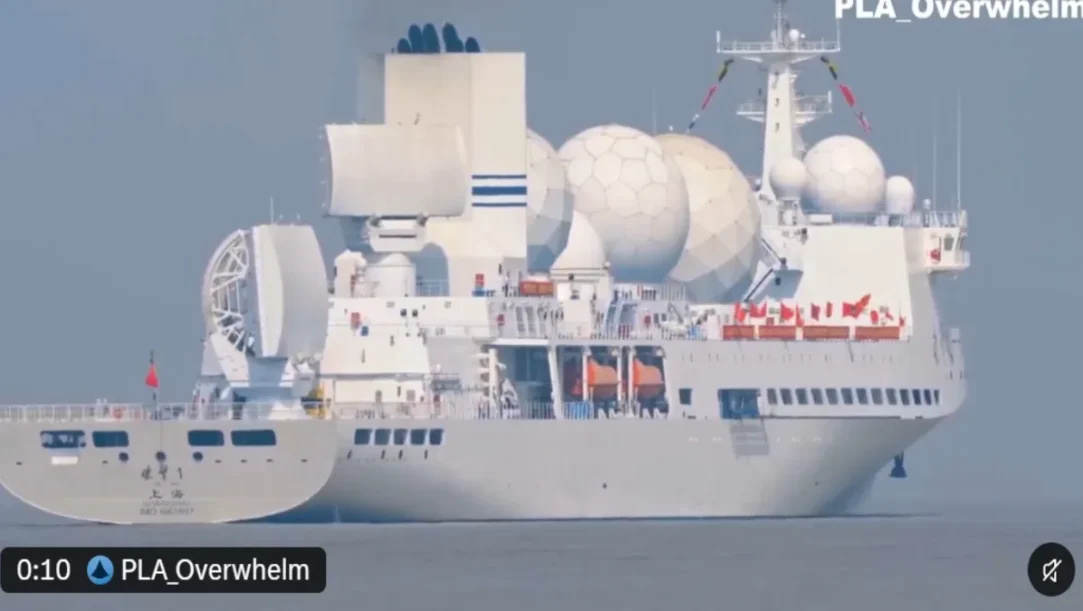
China has put a large new ship into service that can track satellites, rockets and missiles from the sea. The vessel is called Liaowang-1. It weighs about 30,000 tonnes and is roughly 225 metres long and 32 metres wide.
The ship was built at Jiangnan Shipyard in Shanghai and entered service in April 2025. It carries several large white radar domes and high-gain antennas on its deck.
Around 400 people work on board. These systems help the ship receive signals from spacecraft and follow the path of missiles during tests.
China already had smaller ships of the Yuan Wang class for similar work. Liaowang-1 is bigger and can stay at sea longer.
Officially, its main job is to support China’s space programme by tracking launches and satellites when they are far from land-based stations. The same equipment can also pick up signals from other countries’ missiles, aircraft and ships.
China’s🇨🇳 “Eye of Sauron” at Sea:
Liaowang-1
30,000-ton steel beast
Tracks 1,200 targets at once
Hypersonic missiles. Space surveillance.
6,000 km range — nothing hides
3x the size of US🇺🇸 counterpartsThe ocean just got transparent. https://t.co/804fTDVHzB
— China Perspective (@China_Fact) October 24, 2026
Some Chinese reports say the ship can track up to 1,200 air targets at the same time and has a range of about 6,000 kilometres. These figures have not been confirmed by independent sources. Analysts note that the ship is much larger than the main US missile-tracking vessel, the USNS Howard O. Lorenzen, which weighs around 9,500 tonnes.
Because the ship can move, China can place it in different parts of the ocean to cover areas that fixed radars cannot reach. It has been linked to surveillance work in regions such as the Gulf of Oman. Defence experts say vessels like this give China better information on missile tests and space activity far from its own coast.
The ship is not a warship that carries missiles itself. Its value comes from the sensors and the data it can collect and send back. For now, it stands as one of the largest specialised tracking ships operating at sea.
Related posts:
 China’s Tianwen-2 Probe Reaches Earth’s Quasi-Moon Kamo’oalewa in Historic Asteroid Rendezvous
 China’s Property Empire Crumbles: 25% Price Crash Shocks Global Markets
 ¥2.7 Trillion Vanishes: China Stocks Crash as Iran War Fears Explode!
 US Pentagon Report: China Lists Arunachal Pradesh as ‘Core Interest’ Alongside Taiwan
 China Declares War on Crypto Again — Stablecoins in the Crosshairs
 China Real Estate Sector Shaken by Vanke’s Bond Collapse
 World’s Largest ‘Modern’ Crater Discovered in China’s Guangdong Province
 China’s Sixth-Gen Stealth Fighters J-36 and J-XDS Spotted at Secret Base

Leave a Reply