
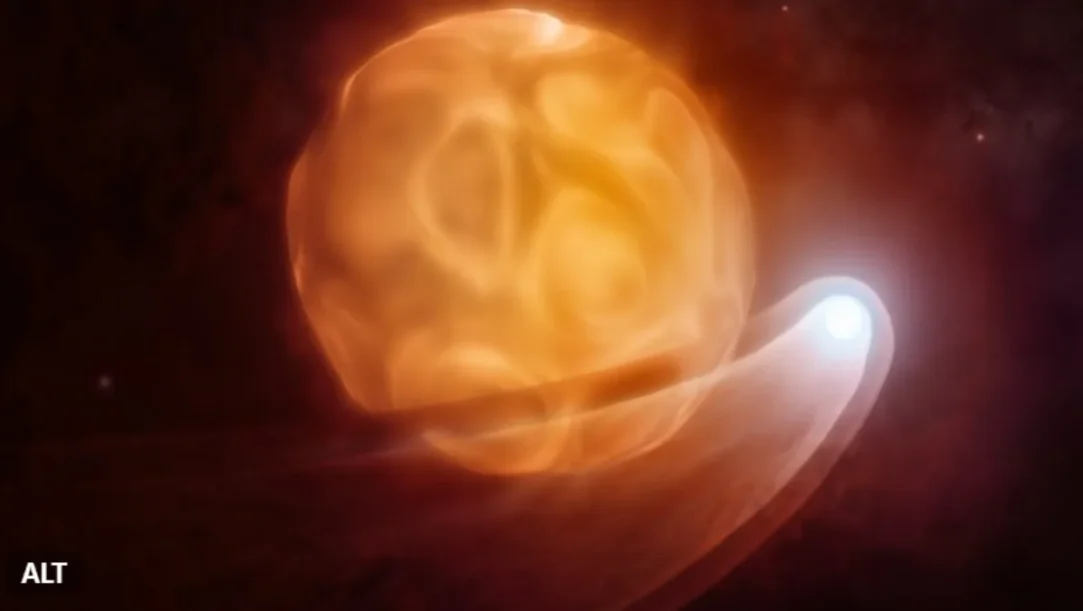
A hidden companion star may be disturbing the atmosphere of Betelgeuse, one of the brightest and most studied stars in the night sky. Astronomers reported the finding after analyzing radio observations collected between 2021 and 2026 using the Atacama Large Millimeter/submillimeter Array (ALMA) and the U.S. National Science Foundation’s Very Large Array (VLA).
The research focuses on Siwarha, a faint companion believed to orbit close to Betelgeuse. Scientists observed changes in the star’s shape and atmospheric structure that appear to match the companion’s movement around the red supergiant.
According to an ALMA Observatory statement, researchers examined Betelgeuse at seven radio frequencies ranging from 22 to 485 gigahertz. The data allowed them to study different layers of the star’s atmosphere.
Companion May Be Moving Through the Atmosphere
The research team found that Betelgeuse looks more elongated when Siwarha is expected to appear farther from the star and more circular when it passes in front of or behind it. The pattern suggests the companion may be pushing through the star’s extended atmosphere and disturbing the surrounding gas.
“This companion is orbiting so close to the star that it actually passes through its extended atmosphere,” said Lynn D. Matthews of MIT Haystack Observatory.
The Ghost in Betelgeuse’s Atmosphere: A Tiny Companion Is Stirring the Giant’s Outer Layers
Betelgeuse has a secret roommate—and it is not being subtle.
The famous red supergiant in Orion’s shoulder already had a dramatic reputation after the Great Dimming of 2019–2020, when it belched a billion tons of material and briefly looked like it might be preparing to explode. Now fresh radio images show the star has largely recovered from that event, yet something else is still shaking its enormous outer atmosphere. That something is a close-in companion star named Siwarha, orbiting so near that it actually plows through Betelgeuse’s extended atmosphere, leaving a detectable wake.
Using the NSF’s Very Large Array and ALMA, a team led by Lynn D. Matthews of MIT Haystack Observatory observed the star at seven radio frequencies between 2021 and 2026. Different wavelengths peer to different depths, giving a layered view from just above the visible surface out to several times the star’s radius. The data show the atmosphere has rebounded: at roughly 2.7 times the stellar radius the gas is back to about 3,500 K—comparable to the star’s own surface temperature. Closer in, the observations also confirmed a long-suspected cool “temperature minimum” and the molecular shell known as the MOLsphere, where temperatures drop to around 2,200 K.
The real surprise is the shape. Betelgeuse’s radio-emitting atmosphere is not perfectly round. It becomes noticeably more elongated (egg-shaped) when Siwarha is expected to be at its greatest apparent separation, and rounder when the companion is passing in front of or behind the giant. The companion itself is far too faint to see directly at these wavelengths, but its gravitational and physical presence is written in the changing outline of its host—like watching ripples on a pond and knowing something is moving just beneath the surface.
Siwarha, named “her bracelet” after Betelgeuse’s Arabic meaning “the hand of al-Jawza,” was proposed in 2024 to explain a mysterious ~2,100-day brightness cycle and has since been supported by other imaging and spectroscopic work. It orbits at only about twice the radius of the supergiant, deep inside the extended atmosphere. Future observations covering more of its orbit, and eventually sharper views from the next-generation Very Large Array, should pin down exactly how this close companion influences the way Betelgeuse sheds material in its final evolutionary stages.
In short: the star that made headlines by almost vanishing has bounced back, but it is no longer alone. A smaller star is actively stirring its outer layers, and radio telescopes have finally caught the disturbances in the act.
— Black Hole (@konstructivizm) October 28, 2026
The companion was not directly visible in the radio images. Instead, astronomers detected its influence by tracking subtle changes in Betelgeuse’s outline over time.
New Clues After the Great Dimming
Betelgeuse drew worldwide attention in late 2019 and early 2020 during an event known as the Great Dimming, when its brightness dropped to unusually low levels. The new observations show that temperatures in parts of the star’s atmosphere have increased since those historic lows.
The ALMA measurements found a brightness temperature of about 2,200 kelvin near the visible surface and roughly 3,500 kelvin farther out in the atmosphere. Researchers said these measurements reveal a complex temperature structure surrounding the aging star.
Betelgeuse is a red supergiant located in the constellation Orion. Scientists say additional observations will be needed to confirm how strongly Siwarha influences the star, but the latest data provides some of the clearest evidence yet that a close companion is reshaping its atmosphere.
Leave a Reply