Ancient Elephant Butchery Site in Tanzania Pushes Back Timeline of Human Megafauna Hunting
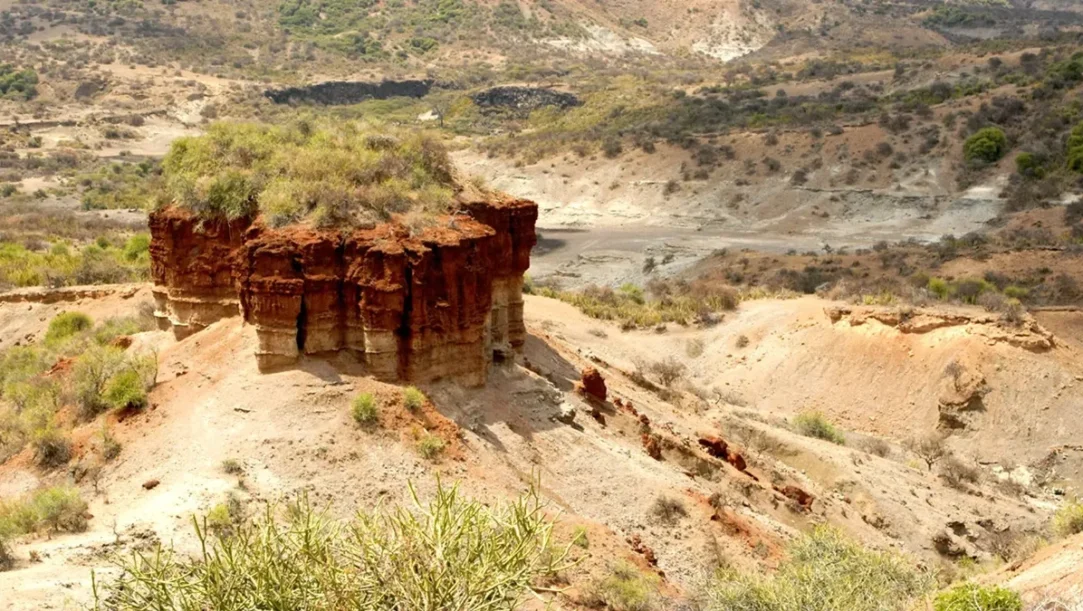
OLDUVAI GORGE, Tanzania — Archaeologists have identified a 1.78-million-year-old elephant butchery site in northern Tanzania, offering the earliest direct evidence that early human ancestors deliberately hunted and processed massive animals for food.
The discovery reshapes a long-running debate over how hominins survived on the East African savanna. Rather than scavenging whatever carcasses they stumbled upon, the findings suggest early humans pursued megafauna with intent. This strategic shift, researchers say, may have supplied the calorie-dense meat needed to fuel larger brains and support growing social groups.
The site, newly named Emiliano Aguirre Korongo (EAK), sits at the base of Bed II within Olduvai Gorge, a formation on Tanzania’s Serengeti Plains long famous for yielding some of the world’s oldest hominin fossils. Researchers first noticed bone fragments eroding from a gully there in early 2022; a full excavation followed once seasonal rains exposed more of the skeleton.
What emerged was the partial carcass of a juvenile Elephas recki, an extinct elephant species that could grow to nearly twice the bulk of today’s African elephants. Scattered nearby, excavators recovered roughly 80 stone tools, most of them simple cutting flakes tied to the Oldowan toolkit — one of humanity’s earliest technologies.
“The food surplus generated by the exploitation of some of these animals would have been a significant advantage for the survival and adaptation of the hominin groups,” the study’s authors wrote.
Proving the elephant was butchered — not simply scavenged after a natural death — required more than counting nearby tools, according to the research team, led by archaeologist Manuel Domínguez-Rodrigo and published this year in the journal eLife. Cut marks alone can be misleading; trampling and erosion often leave similar scars on bone.
So the team turned instead to spatial taphonomy, mapping precisely how bones and tools were distributed across the site, and to “green breaks” — fractures in bone that only occur while it’s still fresh, ruling out damage from centuries of weathering.
Taken together, the researchers concluded, the pattern was inconsistent with a chance discovery. Someone processed that elephant on-site, soon after it died.
The timing matters. Previous evidence at Olduvai had placed organized megafauna butchery closer to 1.5 million years ago. The EAK site pushes that marker back roughly 300,000 years, and the study’s authors note that butchery evidence across Bed II becomes markedly more common after 1.8 million years ago — right as Oldowan tools begin giving way to more sophisticated Acheulean technology.
Fox News Digital reported that it reached out to the study’s lead researcher for further comment; a full response had not been published as of this writing.
The research team says continued excavation across Olduvai’s stratigraphic layers is underway, aimed at determining just how widespread elephant hunting became among early human populations before Homo erectus emerged as the dominant hominin species in the region.