
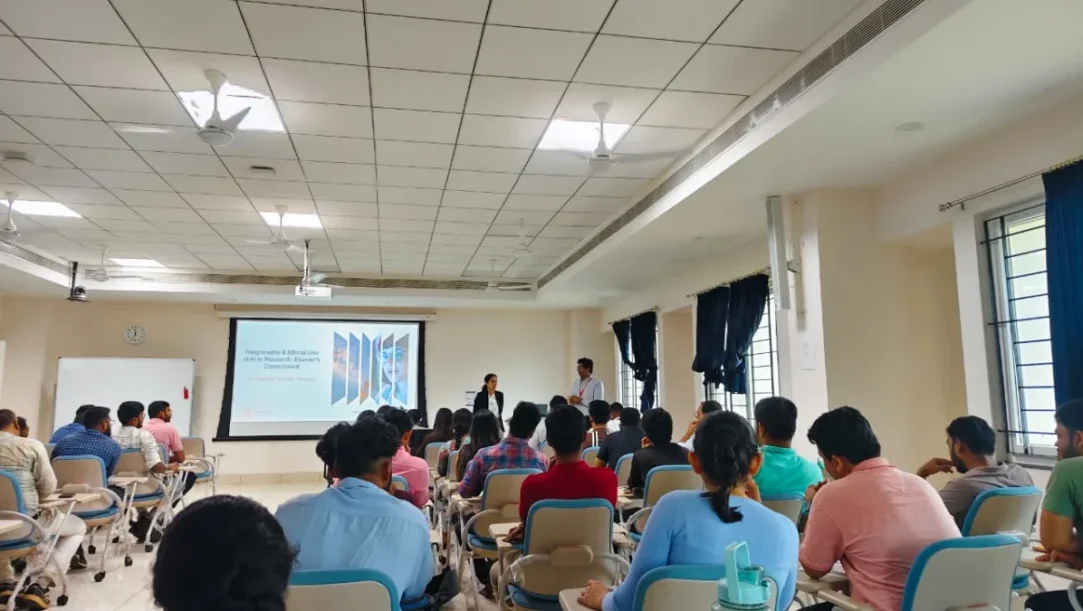
The Knowledge Resource Centre at IIT Dharwad held a workshop on research integrity in the age of artificial intelligence on October 15, 2026. The centre organised the in-person session with Elsevier at the institute’s campus in Dharwad.
Dr. Vinita Saroha, Strategic Engagement Manager for South Asia at Elsevier, led the workshop. Mr. Lavanya T., Solutions Consultant (Research Reference) at Elsevier, joined her.
More than 60 faculty members, research scholars, students, and staff took part, according to the IIT Dharwad post on X.
The session covered the changing research integrity landscape with generative AI, responsible use of AI across the research process, risks such as bias and fabricated content, the need for human oversight and disclosure, authorship and citation rules, and issues of plagiarism and data reliability.
Participants discussed practical scenarios during the interactive meeting.
Topics covered at the IIT Dharwad workshop
Generative AI tools can draft text, summarise papers and suggest citations quickly. Researchers still need to verify every claim.
Workshop on Research Integrity in the AI Era: Responsible and Ethical Use of AI in Research
The Knowledge Resource Centre (KRC), IIT Dharwad, in association with Elsevier, organised an in-person workshop on Research Integrity in the AI Era on 15 October 2026.
The session was led by Dr Vinita Saroha, Strategic Engagement Manager, South Asia, Elsevier, accompanied by Mr Lavanya T., Solutions Consultant (Research Reference), Elsevier.
The workshop covered:
– The evolving research integrity landscape in the age of generative AI
– Responsible and ethical use of AI across the research lifecycle
– Risks of AI-generated content, including accuracy, bias and fabricated information
– Human oversight, verification and disclosure of AI usage
– Authorship, attribution and citation integrity
– Plagiarism, data reliability and publication ethicsMore than 60+ faculty members, research scholars, students, and staff altogether took part in a lively, interactive session featuring practical scenarios and discussion.
We thank Dr Saroha and Mr Lavanya T. for sharing their insights, Elsevier for the partnership, the entire institution leadership for the encouragement, and everyone who joined us in building a culture of responsible AI use in research at IIT Dharwad.
#IITDharwad #ResearchIntegrity #ResponsibleAI #EthicalAI #AIinResearch #Elsevier #KnowledgeResourceCentre #AcademicIntegrity #PublicationEthics
— IIT Dharwad (@iitdhrwd) October 16, 2026
The tools can invent references or present biased information as fact. The workshop stressed that human review is required from the literature search through final submission.
Many journals now ask authors to disclose AI use. Using the tools without saying so can raise questions about originality.
The session also covered proper attribution when AI helps with writing or data analysis. Plagiarism checkers flag AI-generated text, and institutes are adjusting their rules.
Organisers said the aim was to build a culture of responsible AI use in research at the institute.
Responsible AI use and research integrity challenges
Accurate data and proper citation have always been required in academic publishing. AI tools speed up work but can also produce false content that looks convincing. Faculty and students at IIT Dharwad deal with these issues in their regular research.
The workshop showed specific places where problems occur and ways to avoid them. Other Indian institutes have held similar sessions as journals update their policies on AI assistance. Participants received clearer guidance on verification and disclosure.
Stay updated with breaking local stories, civic developments, and Twin City updates in our Hubballi section.
From infrastructure projects to community news, PanAsiaBiz keeps you informed.
Related posts:
 KLE MRC Hospital Hubballi holds arthritis awareness camp with over 100 screened
 Belagavi EUS workshop at KLE Hospital, 7 procedures done
 Davanagere Ayurveda college holds JANANI workshop for 27 mothers
 Hubballi-Dharwad Police Hold One-Day Legal Awareness Workshop
 RV Deshpande Holds Emergency Monsoon Meeting in Dandeli
 KLE Physiotherapy Hubballi Hosts Powerful Self-Defence Workshop for Women’s Day
 V. Somanna Flags Off New Dandeli-Alnavar DEMU Train: A New Era for Regional Travel
 BJP Leaders Convene in Dharwad for 1.5 Lakh Crore Rural Employment Workshop
Leave a Reply